
The smart home of five years ago was mostly about convenience — turning lights on with your voice, locking doors from your phone.
The smart home of 2026 is something fundamentally different.
It generates its own electricity from the sun. It stores that energy in a home battery that keeps the lights on when the grid goes down. It charges your car overnight using power your roof produced during the day. It learns your schedule, adapts to changing electricity prices in real time, and reduces your household carbon footprint as a byproduct of saving you money.
This isn’t a vision of some distant future. Millions of US households are already living this way — and the technology is more accessible and affordable than most people realize.
This guide covers where smart home technology has come from, where it stands today, and — most importantly — where it’s going next.
How the Smart Home Has Evolved: From Remote Controls to AI
Understanding where smart home technology is heading requires a clear picture of how fast it’s already moved.
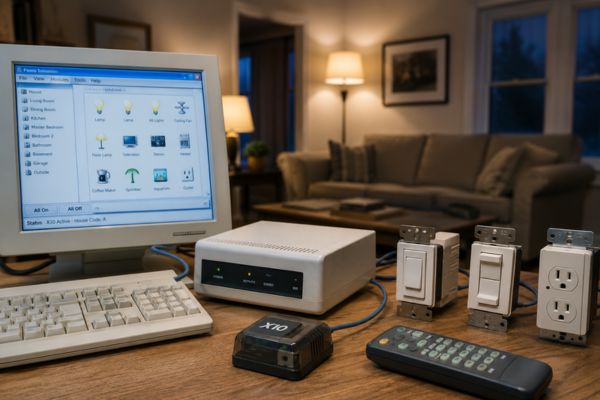
The Early Days: Remote Control and Basic Automation (Pre-2010)
The first “smart home” devices were really just remote-controlled devices with a scheduling feature. X10 — the dominant home automation protocol of the 1990s and 2000s — let homeowners control lights and outlets via powerline signals, programmed through clunky interfaces that required dedicated software and significant technical patience.
The technology worked, but barely. The target audience was hobbyists and engineers, not everyday homeowners. A “smart home” in 2005 meant thousands of dollars in equipment and days of configuration.
The First Consumer Wave: Voice, Apps, and Wi-Fi (2010–2018)
Everything changed when smartphones became universal. Suddenly, the “remote control” was something everyone already had in their pocket — and the app became the interface for a new generation of smart home devices.
The Amazon Echo launched in 2014 and changed the interaction model entirely. Voice control moved smart home technology from a power-user niche into mainstream consumer behavior. Philips Hue (2012), Nest Learning Thermostat (2011), and Ring Video Doorbell (2013) each created their own categories and introduced millions of US consumers to what connected living actually felt like.
By 2018, smart home devices had become mainstream retail products. You could buy a voice-controlled speaker at Costco. Smart plugs were stocking stuffers. The ecosystem was fragmented and frustrating — but it was everywhere.
The Maturity Era: Matter, AI, and Energy Integration (2019–Present)
The industry’s response to fragmentation was Matter — the universal connectivity standard that allows devices from competing ecosystems to work together. Its arrival in 2022 and ongoing expansion in 2024–2026 marks the beginning of the smart home’s maturity phase: devices that work together by default rather than exception.
Simultaneously, AI moved from a buzzword to a functional layer. Modern smart home AI doesn’t just respond to commands — it anticipates behavior, optimizes energy use, identifies anomalies, and makes decisions on behalf of the household. The gap between “automated home” and “intelligent home” is closing.
And the addition of solar, home batteries, and EV charging has transformed the smart home from a network of convenience devices into genuine home energy infrastructure — a development with financial implications that far exceed any single device category.
The Modern Smart Home: What’s Actually Possible in 2026
Before looking at where things are going, it’s worth being specific about where they already are — because the gap between what’s possible and what most people think is possible is larger than most people realize.
What a Fully Configured Smart Home Looks Like Today
A well-configured US smart home in 2026 operates across four distinct layers:
Control layer
Voice assistants (Alexa, Google Home, Siri), smart displays, and smartphone apps provide unified control over every connected device in the home from a single app or a single voice command.
Energy layer
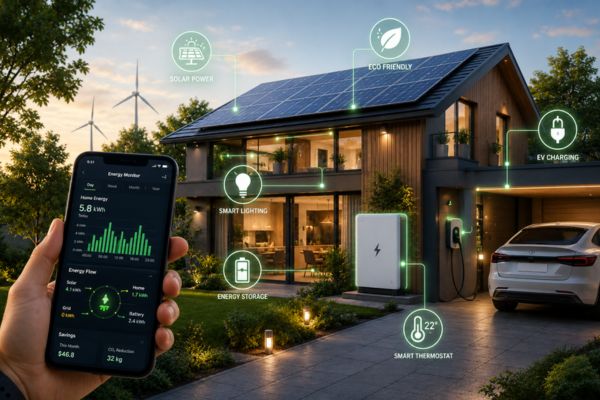
Solar panels generate electricity during the day. A home battery stores the excess. The car charges overnight from stored solar energy. The home’s energy management system dispatches power from battery, grid, or solar depending on which is cheapest or cleanest at any given moment.
Automation layer
Routines and rules operate the home without any manual input. Lights adjust based on time of day and occupancy. The thermostat responds to your location, the weather forecast, and the current electricity rate. The security system arms itself when the last person leaves and disarms when the first person returns.
Intelligence layer
AI monitors patterns, identifies anomalies, makes recommendations, and increasingly makes adjustments autonomously learning which temperature you find comfortable on Tuesday mornings, which security alerts are worth waking you for at 2am, and which appliances are using more energy than they should.
Not every US household has all four layers today. But the technology for all four exists, works reliably, and is available at consumer prices.
Solar Power and the Self-Sufficient Smart Home
Rooftop solar has crossed a threshold in the US market. What was once an expensive, niche upgrade for environmentally motivated homeowners is now a mainstream financial decision for millions of households — particularly in states where electricity rates are high and sunshine is reliable.
How Solar Integrates With a Smart Home
It reduces your electricity bill by generating power during daylight hours. A solar system integrated with a smart home is something more capable.
The hardware that converts solar DC electricity to AC power for household use — now connect to Wi-Fi and provide real-time generation data through apps. You can see exactly how much power your roof is generating at any moment, how much you’ve generated today, and how your generation compares to historical averages.
Coordinate solar generation, home battery storage, and household consumption to optimize the entire energy flow. When the sun is generating more than the home is using, the system automatically routes excess power to the battery rather than back to the grid preserving it for evening use when rates are typically higher.
When solar generation is high and can automatically run energy-intensive tasks dishwasher, laundry, EV charging during peak generation windows rather than peak-rate evening hours.
The Financial Case for Solar in 2026
The economics of residential solar have shifted significantly. The federal solar Investment Tax Credit (ITC) currently provides a 30% tax credit on the cost of solar installation under the Inflation Reduction Act — a significant incentive that remains available through 2032.
In high-electricity-rate states — California, Hawaii, Massachusetts, New York, Connecticut — the payback period on a solar installation has compressed to 5–8 years for many households, with 25+ year panel lifespans making the long-term financial case compelling.
The states where solar makes the strongest financial sense: California, Texas, Florida, Arizona, Colorado, and the Northeast corridor. The states where solar is growing fastest: Texas and Florida, where high summer cooling loads translate directly into high summer electricity generation from rooftop panels.
Solar-Powered Smart Devices (Without Full Rooftop Installation)
Not every solar upgrade requires a full rooftop installation. A growing category of solar-powered smart home devices operates independently charging from sunlight and eliminating both wiring requirements and battery replacement:
- Solar outdoor cameras — eliminate cable runs and battery swaps; charge year-round in most US climates
- Solar landscape and pathway lighting — zero operating cost; auto-on at dusk
- Solar attic fans — reduce attic temperatures in summer, cutting AC load significantly in southern US climates
- Solar-powered weather stations — continuous outdoor monitoring without any power connection
Home Battery Backup Energy Independence When the Grid Goes Down
Home batteries are the piece of smart home infrastructure that moves a household from grid-dependent to grid-resilient. And in 2026, the reasons to consider one go beyond environmental motivation.
Why US Homeowners Are Buying Home Batteries Now
Grid reliability concerns
The US electrical grid is aging, and extreme weather events — hurricanes in the Southeast, ice storms in Texas, wildfires in California — cause increasingly frequent outages. The February 2021 Texas grid failure left millions without power for days in freezing temperatures. For households in vulnerable regions, a home battery isn’t a luxury — it’s contingency planning.
Time-of-use electricity pricing
Utilities in California, Texas, and a growing number of states charge more for electricity during peak demand hours (typically 3–9pm on weekdays). A home battery charged during off-peak hours and discharged during peak hours can reduce electricity costs by $30–$100 per month for households on TOU rates — independent of any solar installation.
Solar self-consumption
Without a battery, excess solar generation is exported back to the grid, often at rates lower than retail electricity costs. A battery captures that excess and uses it at night when generation has stopped, increasing self-consumption from roughly 30% without storage to 70–90% with it.
Resilience value during outages
A whole-home battery backup system (or a critical loads panel connected to a battery) keeps essential circuits — refrigerator, lights, medical devices, phone charging, Wi-Fi router — running during a grid outage for 12–24+ hours depending on consumption.
Tesla Powerwall vs. EcoFlow vs. Alternatives — Understanding the Options
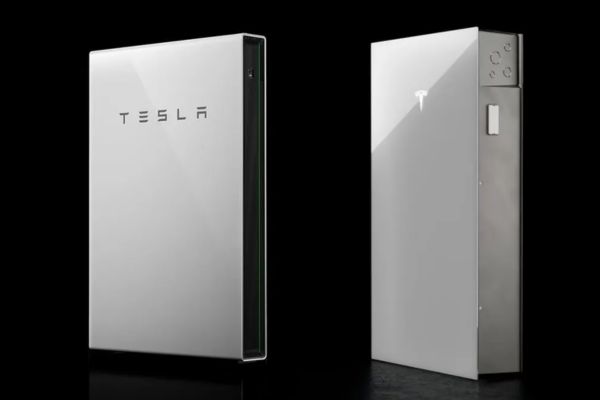
Tesla Powerwall 3
The market-leading whole-home battery solution in the US. Integrates directly with Tesla solar and the Tesla app for unified energy management. 13.5 kWh usable capacity. Designed for whole-home backup with a compatible automatic transfer switch.

EcoFlow DELTA Pro Ultra
A modular, portable-to-permanent home battery system that can be installed without an electrician for basic configurations. More flexible than the Powerwall for renters and homeowners who want battery backup without a full solar integration. Expandable capacity from 6kWh upward.
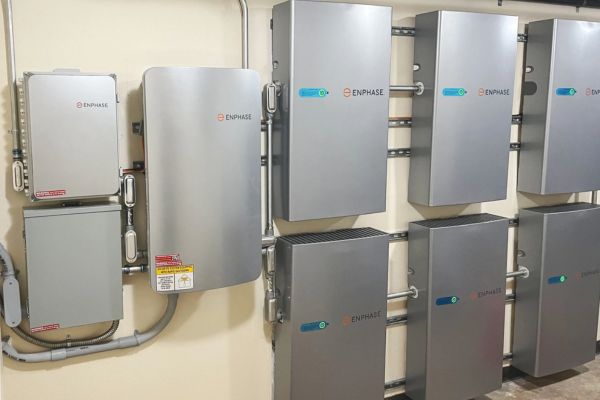
Enphase IQ Battery
Best for homes already running Enphase microinverter solar systems. Modular design (add capacity incrementally). Strong app and smart home integration through the Enphase Enlighten platform.
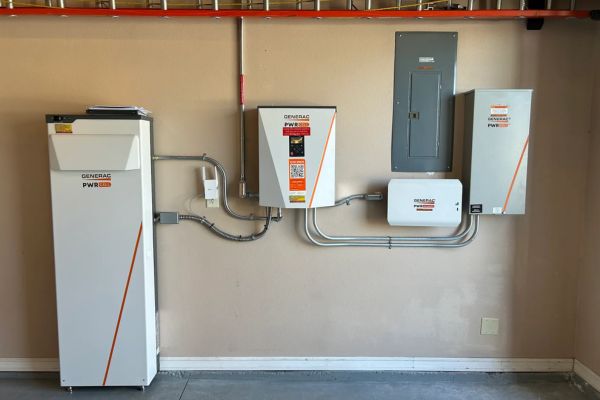
Generac PWRcell
Strong option for households in storm-prone areas (Gulf Coast, Southeast) where Generac’s brand reputation in backup power carries weight.
EV Charging at Home – Where the Smart Grid Meets the Driveway
There are now over 4 million registered electric vehicles in the US — and that number is growing faster than public charging infrastructure. For most EV owners, home charging isn’t just a convenience. It’s the primary way they power their vehicle.
A basic Level 2 home charger plugged into a 240V outlet gets the job done. A smart home EV charger does considerably more.
Level 1 vs Level 2 vs DC Fast Charging – What You Actually Need at Home
Level 1 (120V standard outlet)
The charger that comes with most EVs. Plugs into a standard household outlet. Adds roughly 3–5 miles of range per hour of charging. Adequate for plug-in hybrids or EVs that are driven lightly; too slow for most full EV owners as a primary charging method.
Level 2 (240V dedicated circuit)
The right solution for most US homes. Requires a dedicated 240V circuit – the same type that powers an electric dryer or range. Adds 15-30 miles of range per hour depending on the charger and vehicle. A full charge from near-empty typically takes 6–10 hours – overnight while you sleep.
- DC Fast Charging (DCFC): Requires commercial-grade electrical infrastructure. Not a realistic home installation for residential use. This is what you use at a public charging station on a road trip.
- For most US EV owners: a Level 2 charger installed by a licensed electrician is the right home setup. The installation cost (charger + electrician) typically runs $600–$1,500 depending on electrical panel capacity and the distance from panel to garage.
What Makes an EV Charger “Smart”
A basic Level 2 charger delivers power. A smart EV charger gives you control and integration:
The Top Smart EV Charger Brands in the US Market
ChargePoint Home Flex
most widely compatible across vehicle brands; strong app; adjustable amperage (16A–50A)
Wallbox Pulsar Plus
compact design, strong solar integration, good for garages with limited space
Emporia Smart EV Charger
best value with energy monitoring built in; integrates with Emporia’s whole-home energy management system
Tesla Wall Connector
best for Tesla vehicles specifically; integrates directly with Tesla app and Powerwall energy management
AI and Smart Home Automation – What’s Actually Changing
Artificial intelligence is the most overhyped and simultaneously most underappreciated development in the smart home space. It’s overhyped because manufacturers attach “AI” to products where the feature is trivial. It’s underappreciated because the genuine AI applications in energy management, security, and personalization — are reshaping what a smart home can actually do.
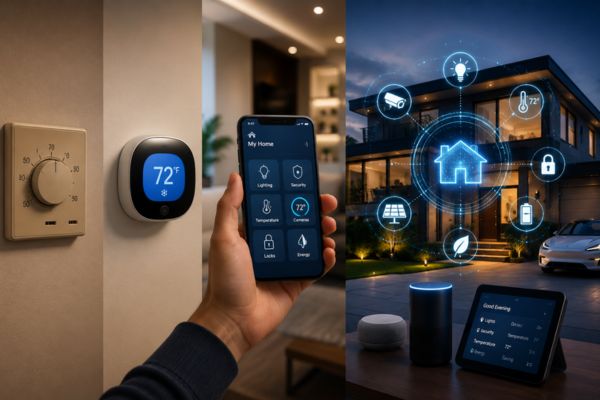
Where AI Is Already Delivering Real Value in Smart Homes
Energy optimization AI energy management systems (Google Nest, Ecobee, Sense, Tesla Energy) analyze historical consumption patterns, weather forecasts, occupancy data, and real-time electricity prices to make continuous micro-adjustments to heating, cooling, and appliance scheduling. The result is a home that runs its energy systems at optimal efficiency without any manual input — and that communicates transparently about what it’s doing and why.
Security and anomaly detection AI-powered security cameras (Ring, Arlo, Google Nest) have moved from motion detection to object recognition. Modern systems distinguish between a person, a car, a package, and an animal — and send alerts only for the events that matter. More advanced systems recognize familiar faces and can flag unfamiliar ones. Anomaly detection goes further: flagging unusual activity patterns (a door opened at 3am on a Tuesday when it’s never been opened before) rather than just presence.
Predictive maintenance Smart appliances and HVAC systems increasingly use AI to predict maintenance needs before failure occurs. A smart HVAC system that detects a refrigerant pressure anomaly and alerts you three weeks before the compressor fails — rather than on the hottest day of July — is a genuinely valuable application of AI in the home.
Voice AI advances The voice assistants of 2026 are meaningfully more capable than their 2020 predecessors. Conversational context (remembering what you asked earlier in a conversation), proactive suggestions (“Your usual grocery delivery day is tomorrow — would you like to review your list?”), and natural language routine building (“Every weekday morning at 7am, do what I did last Tuesday”) represent a qualitative shift in what voice control can do.
What AI in Smart Homes Can’t Do Yet
AI in smart homes is impressive within narrow, well-defined domains — energy optimization, security classification, appliance monitoring. It struggles with:
- Novel situations – AI systems trained on historical patterns perform poorly on events outside that pattern
- Cross domain reasoning – a security AI and an energy AI in the same home rarely share information in ways that produce compound insights
- Explainability – most smart home AI makes decisions without explaining them in ways users find useful or trustworthy
The practical implication for 2026 buyers:
buy AI-enhanced smart home features where the specific application is proven (Nest’s energy management, Ring’s person detection, Sense’s device identification). Be skeptical of broad “AI home assistant” marketing that doesn’t specify what the AI is actually doing.
Sustainability and Smart Homes – The Eco Case for Connected Living
For many US homeowners, sustainability has moved from a value to a practical financial consideration — driven partly by rising energy costs, partly by climate awareness, and significantly by federal and state incentives that make eco-friendly home upgrades financially attractive.
How Smart Home Technology Reduces Household Carbon Footprint
The average US home produces roughly 7.5 metric tons of CO2 equivalent per year from direct energy use. Smart home technology reduces this across multiple pathways:
Heating and cooling optimization
Smart thermostats reduce HVAC energy use by 10–15% on average and heating and cooling represents 47% of home energy use. The carbon math is significant.
Solar self
consumption
A home that generates its own clean electricity and stores it in a battery displaces grid electricity — which in most US states still involves a meaningful proportion of fossil fuel generation.
EV charging
from solar
Charging an EV from rooftop solar rather than the grid is one of the highest-impact emissions reductions an individual household can make. The carbon intensity of driving an EV on solar power is effectively zero.
Load shifting
and grid support
Smart homes that shift energy-intensive tasks to periods of high renewable generation on the grid (typically midday in solar-heavy markets) reduce demand during times when fossil fuel “peaker plants” would otherwise be activated.
Waste
reduction
Smart refrigerators that reduce food waste, smart irrigation systems that reduce water consumption, and smart plugs that eliminate standby power are smaller-scale sustainability contributions that compound across millions of households.
The Financial Incentives for Eco-Friendly Smart Home Upgrades
The Inflation Reduction Act (IRA) has created the largest package of clean energy incentives in US history, several of which apply directly to smart home upgrades:
- Residential Clean Energy Credit: 30% federal tax credit on solar panel systems and home battery storage through 2032
- Energy Efficient Home Improvement Credit: Up to $1,200 per year in tax credits for qualifying efficiency upgrades, including smart thermostats (up to $150 credit), heat pump HVAC systems (up to $600), and insulation improvements
- EV Tax Credit: Up to $7,500 for new qualifying EVs; up to $4,000 for used EVs
- EV Charger Credit: 30% credit (up to $1,000) on home EV charger hardware and installation costs
State and utility-level incentives stack on top of federal credits in many states. California, New York, Massachusetts, Colorado, and Illinois have particularly robust state programs.
Future-Proofing Your Smart Home – What to Buy Now vs. What to Wait For
Not every emerging technology is ready to buy today. Here’s an honest assessment of what to act on now and what to monitor.
Buy Now – Mature Technology with Strong ROI
- Smart thermostat — Proven technology, strong financial return, federal tax credit available. No reason to wait.
- Level 2 EV charger — If you own an EV, smart Level 2 home charging is essential infrastructure. Install now; smart features only improve with firmware updates.
- Home solar (if you own your home, have adequate roof) — 30% federal tax credit through 2032 makes now an excellent time. Waiting reduces the financial incentive and delays the payback period.
- Matter-compatible smart home devices — The ecosystem standard is established and expanding. Buying Matter-compatible devices now avoids the ecosystem lock-in problem that frustrated the previous generation of smart home buyers.
- Robot vacuum — Mature, reliable, genuinely time-saving. No meaningful technology step-change is imminent that would make current models obsolete.
Buy Strategically — Good Now, Getting Better
- Home battery storage — Financially compelling in high-rate states and for homes with solar. Prices continue to decline (~5–10% per year). If you’re in a storm-prone area or on TOU pricing, buy now. Otherwise, waiting 2–3 years may improve the economics further.
- AI security cameras — Current generation delivers genuine value. Next generation (improved facial recognition, cross-camera coordination) is in active development. Current models are good; 2027–2028 models will likely be meaningfully better.
- Smart appliances with Matter — Matter appliance support is expanding but not yet universal. If you’re replacing a failing appliance today, check for Matter compatibility. If you’re buying ahead of need, the ecosystem will be more complete in 12–18 months.
Wait – Emerging Technology Not Yet Ready
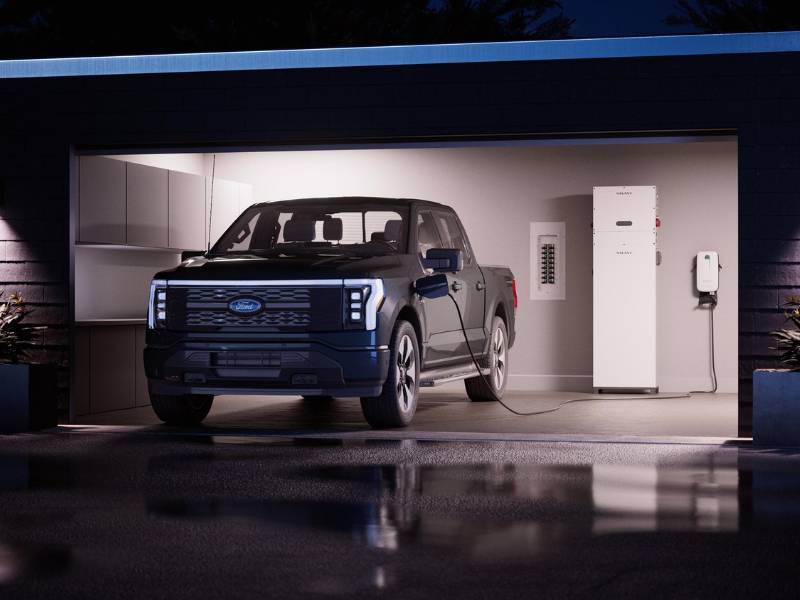
- Vehicle-to-Home (V2H) charging — The technology is real (Ford F-150 Lightning, Rivian R1T), but compatible EV models, bidirectional charger hardware, and utility interconnection rules are still limited. Watch this space; it will be transformative when mature.
- Whole-home AI energy management — Individual AI applications (Nest, Sense) are mature. True whole-home AI that coordinates across all systems simultaneously (solar, battery, EV, HVAC, appliances) is in early commercial deployment. Expected mainstream availability: 2027–2028.
- Smart glass and electrochromic windows — Tinting on demand; no blinds required. The technology works but costs remain prohibitive for most residential applications ($50–$100 per square foot). Watch for price compression over the next 3–5 years.
- Solid-state home batteries — Higher energy density, longer life, lower fire risk than current lithium-ion batteries. Currently in development at major manufacturers. Residential availability expected 2027–2029.
The Smart Home Innovations Worth Watching in 2026 and Beyond
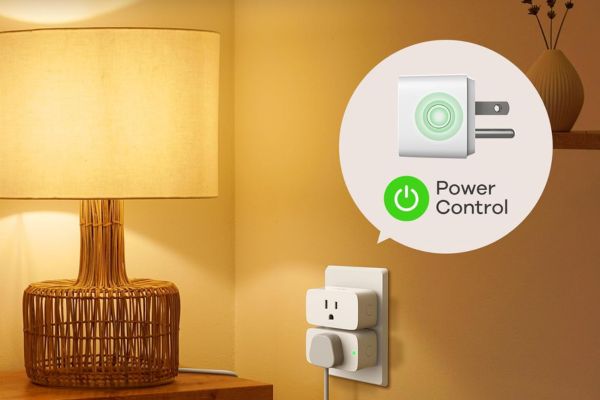
Matter’s Expansion Into Appliances
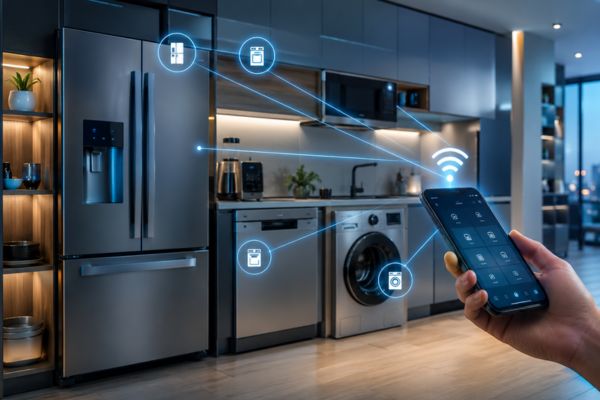
Matter’s device category list is expanding. Cameras, washing machines, refrigerators, and cooking appliances are in active development for Matter certification. When major appliance categories achieve Matter compatibility, the fragmentation that currently complicates smart home management for many US households will largely resolve. Expected timeline: 2026–2028 for most major categories.
AI Agents for Home Management
The next frontier in smart home AI isn’t a better voice assistant — it’s an autonomous agent that manages your home across multiple systems simultaneously. Early versions are already emerging: Google’s Home AI routines, Amazon’s Alexa+ subscription tier, and Apple’s evolving HomeKit intelligence layer are all moving toward systems that don’t just respond to commands but proactively manage home conditions, energy use, and security with minimal human input.
The practical implication: within 2–3 years, “set it and forget it” home automation will become meaningfully more capable than what’s available today.
Grid Interactive Buildings
Utilities in California, Texas, and several northeastern states are piloting programs that allow smart homes to participate in demand response — automatically reducing consumption or discharging battery storage back to the grid during peak demand periods in exchange for bill credits or payments. Early programs pay participating households $50–$200 per summer season. As these programs scale, smart home hardware becomes not just a cost reducer but a revenue generator.
Passive House Integration With Smart Technology
The Passive House building standard — which uses advanced insulation, air sealing, and heat recovery ventilation to reduce heating and cooling loads by up to 90% — is gaining traction in new US construction. Smart home technology integrated into a Passive House structure is the most energy-efficient residential configuration currently achievable. As more US builders offer Passive House options and smart home pre-wiring becomes standard in new construction, the two trends converge into homes that are both genuinely comfortable and nearly self-sufficient from an energy perspective.
Common Smart Home Future-Trends Mistakes (And How to Avoid Them)
Mistake 1: Buying first-generation versions
of emerging technology
Early-generation home batteries, EV chargers, and solar inverters have been materially improved by second and third generations — at lower prices. For categories not yet fully mature (V2H, whole-home AI energy management), patience delivers meaningfully better products at lower cost. The exception: federal incentives that expire or reduce create genuine urgency where the economics favor acting now.
Mistake 2: Ignoring the electrical panel Solar, home batteries, EV chargers, and smart appliances
All place demands on your home’s electrical panel. Many US homes — particularly those built before 1990 — have 100-amp service panels that are insufficient for the full suite of modern smart energy upgrades. A panel upgrade to 200-amp service ($1,500–$4,000) is frequently a prerequisite for solar + battery + EV charging. Budget for this before committing to the full energy upgrade stack.
Mistake 3: Choosing ecosystem-locked energy products
Tesla’s energy ecosystem (Solar + Powerwall + Wall Connector) is excellent when complete — but it creates significant ecosystem lock-in. If you later want to switch inverter brands or add a non-Tesla EV, compatibility friction increases. Where possible, choose energy management systems with open APIs and broad third-party integration (Enphase, Emporia) to preserve flexibility.
Mistake 4: Underestimating installation complexity
Solar, home batteries, and EV chargers all require professional installation — and in some cases, utility notification, permit filing, and inspection. In California, the interconnection process for solar + battery can take 4–12 weeks after installation. Factor installation lead times and permitting timelines into your planning.
Mistake 5: Treating sustainability claims at face value
Not all “smart” or “eco” product claims hold up under scrutiny. A smart device that requires frequent battery replacement has a different environmental profile than a solar-powered equivalent. A “smart” appliance that uses more standby power than a standard model because of its always-on Wi-Fi radio is a net negative for energy efficiency. Evaluate products on actual energy consumption data, not marketing language.
Mistake 6: Overlooking utility programs and incentives
Many US utility companies offer demand response programs, battery storage incentives, EV charging rebates, and solar buyback programs that meaningfully improve the economics of smart energy upgrades. These programs are frequently unknown to customers and require active enrollment. Call your utility before finalizing any energy upgrade purchase — not after.
The Best Smart Living & Future Trends Devices for 2026
Our recommendations across every category in this pillar, based on testing, specifications, and real-world performance in US market conditions.
Best Solar Powered Smart Devices
Top picks: Eufy SoloCam S340 (solar camera), Govee Solar Pathway Lights, Ring Solar Pathlight
Read More →
Best for homes with existing rooftop solar: Enphase IQ8 microinverter system with Enlighten monitoring
Read More →
Best Home Battery Backup
Tesla Powerwall 3 — best whole-home backup; best for Tesla solar households
Read More →
EcoFlow DELTA Pro Ultra — best modular, expandable option; fastest setup
Read More →
Enphase IQ Battery 10T — best for Enphase solar system households
Read More →
Best Home Battery Backup
ChargePoint Home Flex
Read More →
Wallbox Pulsar Plus — best for space-constrained garages with solar integration
Read More →
Tesla Wall Connector — best for Tesla vehicle owners
Read More →
Best AI-Enhanced Smart Home Devices
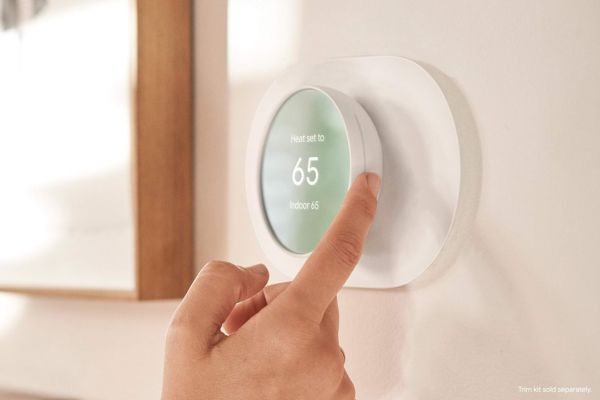
Google Nest Learning Thermostat (4th Gen) — best AI energy optimization
Read More →
Sense Energy Monitor — best AI device identification and consumption insight
Read More →
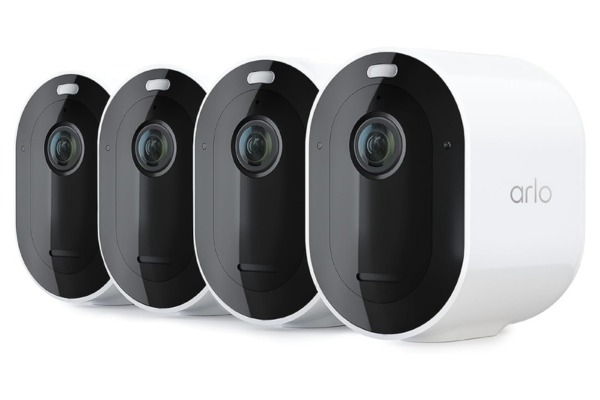
Arlo Pro 5S — best AI-powered security camera with person/package/vehicle detection
Read More →
Best for Smart Home Sustainability
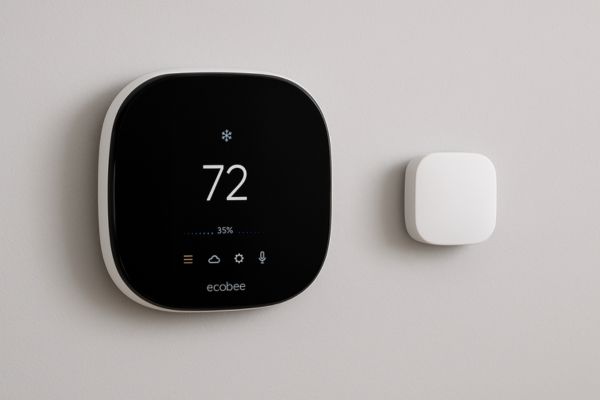
Ecobee SmartThermostat Premium — best for whole-home energy optimization with room sensors
Read More →
Emporia Vue 2 — best whole-home energy monitor for sustainability tracking
Read More →
Winix 5500-2 — best smart air purifier for indoor air quality monitoring
Read More →
Frequently Asked Questions About Smart Home Future Trends
For most US homeowners with adequate roof space and access to the 30% federal tax credit, yes — particularly in high-electricity-rate states. The ITC is available through 2032, but locking in the current 30% rate and beginning the payback period sooner improves lifetime financial returns. Get 3+ quotes from certified installers; pricing varies significantly by region and installer.
Tesla warrants the Powerwall to maintain at least 70% of its original capacity after 10 years. In practice, well-maintained units typically last 12–15 years before capacity degrades to the point where replacement is warranted. The warranty also guarantees unlimited charging cycles during the coverage period — Tesla does not limit cycle count.
A generator (gas or propane) produces electricity on demand by burning fuel. A home battery stores electricity from the grid or solar and discharges it when needed. Batteries are silent, require no fuel, need no maintenance, and integrate with solar for ongoing charge. Generators provide essentially unlimited runtime as long as fuel is available. For most urban and suburban US households, a battery (possibly supplemented by a small generator for extended outages) is the more practical solution. For rural households with longer potential outage durations, a generator remains valuable.
Hardware costs $200–$800 depending on brand and amperage (32A vs 48A). Electrical installation adds $200–$1,000+ depending on how close your electrical panel is to the charging location and whether panel upgrades are needed. Total installed cost typically falls between $500 and $1,500 for straightforward installations. The federal EV charger tax credit covers 30% of hardware and installation costs (up to $1,000).
In practice, most US homes can reduce grid dependence significantly but not achieve complete independence year-round. Solar generation varies seasonally — a system sized for summer generation produces far less in winter months and in extended overcast periods. A battery extends solar self-consumption but not to full annual independence in most climates. “Grid-resilient” is a more accurate target than “off-grid” for most US suburban and urban households. Rural homeowners in high-sun regions with large battery banks can come closer to genuine energy independence.
The IRA provides tax credits for: solar panel systems (30% of cost), home battery storage (30% of cost), heat pump HVAC systems (up to $600 credit, up to $2,000 for heat pump water heaters), smart thermostats (up to $150), new EVs (up to $7,500), used EVs (up to $4,000), and EV charging equipment (30% up to $1,000). Eligibility conditions apply. Consult a tax professional for your specific situation, and visit energystar.gov/taxcredits for current guidance.
Yes, but with limited vehicle and charger compatibility. The Ford F-150 Lightning, Ford Escape PHEV, and certain Rivian models support V2H with compatible bidirectional chargers. The Wallbox Quasar 2 and Ford Charge Station Pro are among the available bidirectional charger options. V2H is a genuinely powerful capability — a 100+ kWh truck battery can power an average US home for several days — but the ecosystem of compatible vehicles and chargers is still limited. Expansion is rapid; expect broader compatibility by 2027–2028.
The Smart Home Is Becoming Energy Infrastructure — Here’s How to Get Ahead of It
The decisions you make about your home’s energy setup in the next 2–3 years will matter for the next 15–20. Solar installations made today will be generating power in the 2040s. EV chargers installed now will serve vehicles that don’t exist yet. Home batteries purchased with current federal incentives will provide resilience through grid challenges that are only going to intensify.
The smart home has grown up. It’s not just about convenience anymore.
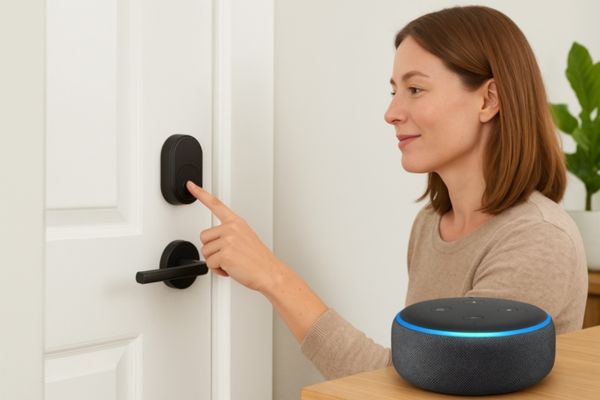
Matter Explained – What the New Standard Means for Your Home
Related Guides
Stay ahead with the latest smart living trends. Explore sustainable technologies, energy solutions, and innovative ideas shaping the future of modern homes.
Ecobee Smart Thermostat Premium Review: The Best Smart Thermostat for Most US Homes?

Let’s be honest. A thermostat isn’t exactly the most exciting thing you’re going to buy for your home. It’s not…
Energy Monitoring Devices Explained: Finally Know Where Your Money Is Going
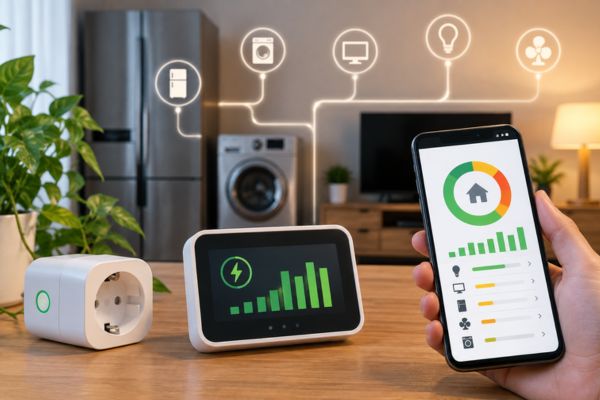
Every month, an electricity bill arrives. You look at the total, wince a little, and then move on with your…
Smart Lighting 101: Benefits, Basics, and Where to Start
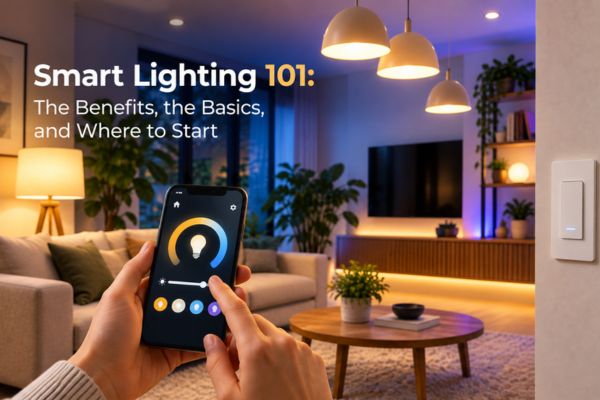
Here’s something that catches most people off guard: the first time they walk into a room and the lights come…
Smart Plugs: The Simple Energy Saver Most Homeowners Overlook
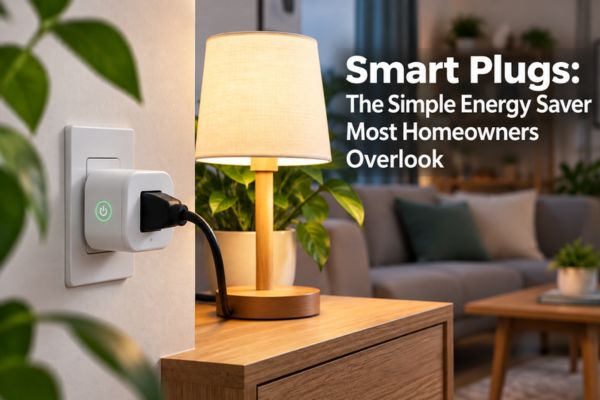
There’s a good chance something in your living room is costing you money right now. Not because it’s running because…
How Smart Thermostats Save Money: The Real Numbers (And When They Don’t)
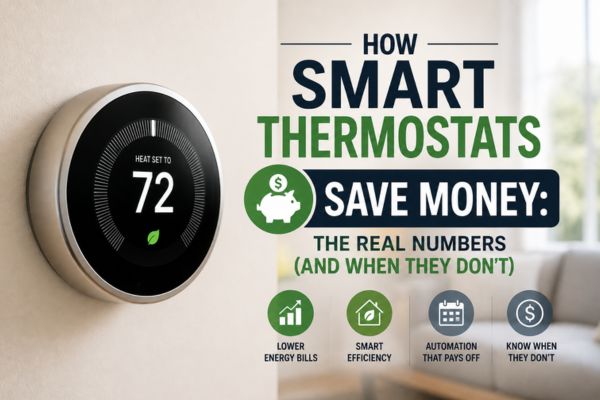
Every smart thermostat review says the same thing: install one and save money. The claims range from $50 a year…




Stay Ahead in Smart Living
Get updates on the latest devices, trends, and deals straight to your inbox.