

Disclosure: Some links here are affiliate links. We may earn a commission at no extra cost to you. As an Amazon Associate, AutomateVerge earns from qualifying purchases. Read our affiliate disclosure.
Every smart thermostat says the same thing: install one and save money. The claims range from $50 a year to $400 a year. Manufacturers advertise up to 26% savings. The EPA says around 8%.
So who’s right?
The honest answer: both depending on your home, your climate, your current thermostat habits, and crucially, how you configure your smart thermostat after installation.
Smart thermostats save the average US household $130–$260 per year on heating and cooling costs, representing a 15–23% reduction in HVAC energy consumption. But those numbers come from homes where the thermostat is correctly configured and actually doing its job. A study of 1,385 households found no statistically significant difference in energy use between homes with and without smart thermostats because most owners never set them up to do anything beyond holding a fixed temperature.
This article covers both sides honestly: how smart thermostats actually generate savings, what the data says about real-world results, the five factors that determine how much you’ll save, and how to make sure yours is actually working for you.
Why Heating and Cooling Costs Are Worth Focusing On
Before getting into thermostat mechanics, it helps to understand the scale of the opportunity.
The average American household spent approximately $2,340 on total energy. Space heating and cooling account for roughly 48% of household energy use about $1,123 per year.
Household utility costs have risen 41% over the last five years. The number your thermostat controls your HVAC spending is not only your largest single energy category but also the one growing fastest.
That makes heating and cooling the highest-leverage target for energy savings in most homes. A 10–15% reduction in HVAC costs saves more money than a 10–15% reduction in lighting, appliances, or water heating combined. A smart thermostat attacks the biggest line item directly.
How Smart Thermostats Actually Generate Savings
A standard programmable thermostat saves energy when you program it and most people never do. Smart thermostats automate what programmable thermostats required manual effort to achieve. The savings come from five specific mechanisms.
The foundation of thermostat energy savings is simple: your home doesn’t need to be at 70°F when nobody’s in it.
The US Department of Energy says homeowners can save up to 10% per year on heating and cooling by adjusting their thermostat 7–10°F for 8 hours per day. During a typical workday 9am to 5pm that’s 8 hours of reduced HVAC load without any sacrifice in comfort.
A smart thermostat automates this completely. It learns when you leave and returns the home to your preferred temperature before you arrive so you walk in to a comfortable home without the system having run at full comfort levels all day.
This single feature reliable, automated temperature setback is responsible for the majority of the energy savings most households experience.
Geofencing uses your smartphone’s GPS to detect when you’ve left home and when you’re on your way back. When the last household member’s phone leaves the geofence boundary, the thermostat shifts to energy-saving mode automatically. When a phone approaches home, it starts conditioning again.
No schedule. No remembering. The system responds to where you actually are rather than where a programmed schedule assumes you’ll be.
This matters most for households with irregular schedules shift workers, parents with unpredictable school pickup times, remote workers who sometimes work from home and sometimes don’t. A fixed schedule wastes energy on days when reality doesn’t match the plan; geofencing doesn’t.
The Google Nest Learning Thermostat and Ecobee SmartThermostat Premium both use machine learning to observe your manual temperature adjustments over one to two weeks and build a schedule automatically.
Rather than requiring you to program a schedule the step most thermostat owners skip the device watches what you do and does it for you going forward. Studies show that installing a smart thermostat leads to an average 10–15% reduction in energy used for heating and cooling in typical households, with results even higher for homes with consistent scheduling and automation.
The Nest’s learning capability was validated in an independent study commissioned by Google: over a 2-year period across thousands of US homes, Nest thermostats saved an average of 10–12% on heating bills and 15% on cooling bills compared to baseline consumption before installation.
Before smart thermostats, leaving the house with the heat on meant returning to a warm home and a larger energy bill. There was nothing you could do about it once you’d left.
With a smart thermostat, you can adjust your home’s temperature from anywhere the office, the airport, another city. Left for a two-week vacation and forgot to set the thermostat to vacation mode? Fix it in 30 seconds from your phone.
This capability doesn’t generate savings by itself but it closes the gaps that standard and programmable thermostats can’t. A smart thermostat can be right 100% of the time in a way that requires human memory to achieve.
The usage awareness component is underrated. Ecobee and Nest both provide detailed monthly energy reports showing exactly how many hours your system ran, what percentage was due to heating vs. cooling, and how your usage compares to similar homes in your area.
Seeing that your HVAC ran 340 hours last month prompts different behavior than a utility bill that shows kilowatt-hour totals without context. Awareness of consumption patterns consistently produces behavioral changes that reduce costs independent of the thermostat’s automated features.
The Real World Savings Data What Research Actually Shows
Multiple independent studies have measured smart thermostat savings in real US homes. Here’s an honest summary of what they found:
According to ENERGY STAR, smart thermostats reduce annual heating and cooling energy costs by about 8%, translating to roughly $50 per year for the average household. This is the most conservative credible figure and it’s the EPA’s conservative baseline, not a ceiling.
ENERGY STAR figures are calculated as a household average across all climates, all home sizes, and all thermostat behaviors. They deliberately err conservative to avoid overstating benefits.
Field studies from utility companies and independent researchers find higher savings than the ENERGY STAR baseline:
- Ecobee data (50,000+ US homes): Average savings of 23% on HVAC costs EPA-verified: Ecobee Premium saves 23% on HVAC costs.
- Google Nest independent study: 10–12% on heating, 15% on cooling in US homes
- California PG&E field trial: 6% drop in total electricity usage; highest-engagement users saved up to 10%, with savings peaking at 17% in summer
- HVAC Base analysis (2026): Smart thermostats save the average US household $130–$260 per year a 15–23% reduction in HVAC energy consumption based on EPA-verified field study data
This matters and shouldn’t be dismissed. The study’s findings don’t mean smart thermostats don’t work they mean they don’t work automatically for everyone. The common failure mode: households that install a smart thermostat, set it to hold a fixed comfortable temperature, and never configure scheduling, geofencing, or learning features. In those homes, the thermostat functions identically to a standard thermostat just a more expensive one.
The data on savings is only as good as the user’s willingness to let the device do its job. This is the most important sentence in any smart thermostat savings discussion.
How Much Will You Specifically Save? The 5 Factors That Determine Your Result
The range between $50/year and $394/year isn’t random it’s explained by five measurable factors specific to your home.
dollar savings from a percentage reduction.
A 15% reduction in HVAC costs means:
- High-HVAC household ($2,000/yr on heating/cooling): ~$300 savings
- Average household ($1,123/yr): ~$168 savings
- Mild-climate household ($600/yr): ~$90 savings
The math is straightforward: if your HVAC bill is already low (Southern California, Pacific Northwest), the dollar savings are proportionally smaller even with the same percentage reduction.
Highest-savings climates: Texas, Florida (high cooling loads), New England, Upper Midwest, Rockies (high heating loads) Modest-savings climates: Pacific Coast, mild Southeast, areas with already-efficient heat pump systems
This is the factor most savings calculators ignore and it’s arguably the most important one.
Smart thermostats save money by doing what a perfectly disciplined human would do: turn the temperature down when nobody’s home, adjust it before you arrive, never forget to set vacation mode. If you already do all of this manually and consistently, a smart thermostat offers modest incremental savings. If you currently leave your thermostat at 70°F year-round regardless of occupancy as most households do the savings potential is substantial.
Highest potential: Households currently running a fixed temperature 24/7 Moderate potential: Households that turn temperatures up/down manually but inconsistently Modest potential: Households that already run strict manual schedules consistently
Your HVAC system type significantly affects how much a smart thermostat can save.
- Central air and forced-air gas heating: The best fit for smart thermostat savings responds quickly to setback and recovery cycles, compatible with all major smart thermostats
- Heat pumps: Smart thermostats designed for heat pumps (Ecobee and Nest both have heat pump-compatible modes) can manage the complexity of heat pump operation effectively but generic smart thermostats not designed for heat pumps can actually increase costs by triggering auxiliary electric resistance heat unnecessarily
- Electric resistance heating (baseboard): Compatible smart thermostats exist, but fewer options. Savings potential is high because electric resistance heat is expensive to run but compatibility must be verified before purchasing
- Boiler and radiant systems: Slower system response means setback savings are lower the system takes longer to recover from a setback and may run longer to reach target temperature than the energy saved during setback
The average US household paid $154–$178/month for electricity in 2025, up 9.6% year-over-year.
Higher electricity rates mean larger dollar savings from the same percentage reduction. Households in high-rate states California ($0.28–$0.35/kWh), Massachusetts ($0.27/kWh), Connecticut ($0.29/kWh) save significantly more in dollar terms than households in low-rate states like Louisiana ($0.10/kWh) or Oklahoma ($0.11/kWh).
If your utility offers time-of-use (TOU) pricing lower rates during off-peak hours, higher rates during peak demand windows smart thermostats add another savings layer: they can pre-cool or pre-heat your home during low-rate periods and reduce HVAC load during expensive peak hours. In areas with active demand response programs, smart thermostats earn an additional $20–$200 annually in utility credits.
Larger homes with more conditioned space have more savings potential the HVAC system is larger, runs more, and costs more. A 15% reduction on a larger system means more dollars saved.
Insulation quality affects how quickly your home loses the temperature setback benefit. A well-insulated home holds temperature longer during setback periods meaning the system runs less to recover. A poorly insulated home loses the setback benefit faster.
The Real Payback Period
At what point does a smart thermostat actually pay for itself?
Smart thermostats typically reach positive cash-flow territory within 12 to 18 months of installation for optimal setups. Here’s the math for the most common scenarios:
| Thermostat | Cost | Annual Savings (avg) | Payback Period |
|---|---|---|---|
| Google Nest Thermostat | ~$130 | ~$150–$180 | 8–10 months |
| Google Nest Learning | ~$200 | ~$170–$220 | 10–14 months |
| Ecobee SmartThermostat Premium | ~$249 | ~$180–$260 | 11–16 months |
A real-world example: A Houston, TX family in a 2,800 sq ft home saved $394 in their first year with the Ecobee Premium a payback period of just 7.6 months on a $249 purchase. This represents the higher end of the savings range, achievable in high-HVAC-spend households in warm climates.
Utility rebates accelerate payback significantly. Many utility companies offer instant $50–$100 rebates for installing ENERGY STAR-certified smart thermostats. AEP Ohio rebates $50. PECO offers $75. Mass Save provides $100 off qualifying thermostats. At $100 off a $249 thermostat, your effective cost drops to $149 cutting the payback period nearly in half.
Check your utility’s website or the DSIRE database at dsireusa.org for available rebates in your area before purchasing.
How to Maximize Your Smart Thermostat Savings
The gap between $50/year and $394/year savings is almost entirely explained by how well the thermostat is configured. Here’s what actually moves the needle:
Geofencing is the single highest-impact configuration most users never complete. Without it, your thermostat runs on a fixed schedule that may not match your actual comings and goings.
In the Ecobee app: enable SmartSensor occupancy detection and the eco+ geofencing feature. In the Nest app: enable Home/Away Assist under Settings → Home/Away.
This step alone can add 5–8% to your energy savings by ensuring the system doesn’t heat or cool an empty house.
A home left at 70°F for a 10-day vacation wastes more energy than a month of commuting setbacks saves. Before every trip, set your thermostat to vacation mode (typically 60°F in winter, 85°F in summer) the widest temperature band your pipes and belongings can safely tolerate.
Most smart thermostats have a dedicated vacation or away mode in the app. Set it before you leave; turn it off remotely when you’re on your way home.
Bigger temperature setbacks during unoccupied periods save more energy. The Department of Energy’s 7–10°F setback recommendation is a good starting point setting back from 70°F to 62°F while you’re at work covers that range.
The concern most people have that it costs more energy to reheat a cold house than to maintain temperature is a persistent myth. Smart thermostats automate what programmable thermostats required manual effort to achieve and the physics consistently show that setback saves energy regardless of how quickly the system recovers.
If your utility offers a demand response or energy rush hour program and many US utilities now do connecting your smart thermostat to it can generate $20–$100 in annual bill credits with no effort beyond the initial enrollment.
Both Ecobee and Nest support demand response programs from hundreds of US utilities. Check the app’s energy dashboard for available programs in your area. In areas with active demand response programs, smart thermostats earn an additional $20–$200 annually in utility credits.
Both Ecobee and Nest provide detailed monthly energy reports accessible in their apps. Spend 5 minutes yours each month:
- How many runtime hours did your system log?
- How does it compare to the previous month?
- What percentage of runtime was heating vs. cooling?
- How does your home compare to similar homes in your area?
Households that actively monitor their energy reports consistently save more than those who set the thermostat and never look at the data again. Awareness drives behavior and behavior drives savings.
Most modern smart thermostats require a C-wire (common wire) to power the thermostat’s Wi-Fi radio continuously. Homes without a C-wire may need an adapter or a C-wire installation.
Both Ecobee and Nest include solutions: Ecobee includes a Power Extender Kit (PEK) that works without a C-wire; Nest has a compatibility checker at nest.com/compatibility. Verify your system’s compatibility before purchasing to avoid installation surprises.
Is a Smart Thermostat Worth It? A Honest Assessment by Household Type
High Savings Potential Strong Recommendation
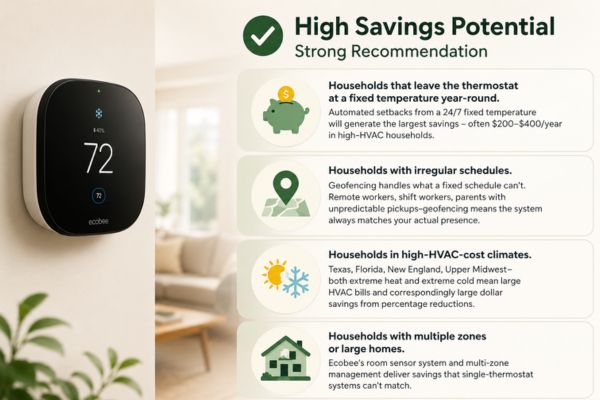
- Households that leave the thermostat at a fixed temperature year-round. This is the highest-opportunity scenario. Automated setbacks from a 24/7 fixed temperature will generate the largest savings often $200–$400/year in high-HVAC households.
- Households with irregular schedules. Geofencing handles what a fixed schedule can’t. Remote workers, shift workers, parents with unpredictable pickups geofencing means the system always matches your actual presence.
- Households in high HVAC-cost climates. Texas, Florida, New England, Upper Midwest both extreme heat and extreme cold mean large HVAC bills and correspondingly large dollar savings from percentage reductions.
- Households with multiple zones or large homes. Ecobee’s room sensor system and multi-zone management deliver savings that single-thermostat systems can’t match.
Moderate Savings Potential Still Worth It
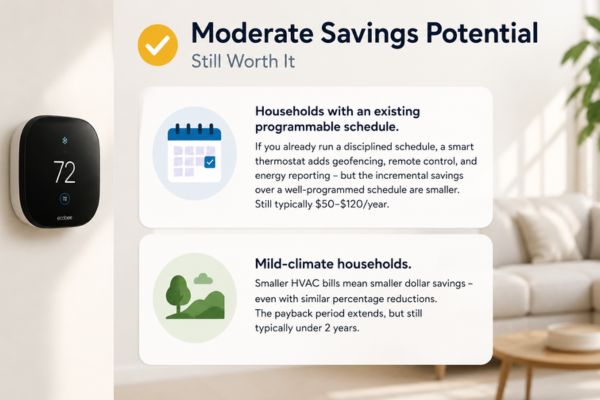
- Households with an existing programmable schedule. If you already run a disciplined schedule, a smart thermostat adds geofencing, remote control, and energy reporting but the incremental savings over a well-programmed schedule are smaller. Still typically $50–$120/year.
- Mild-climate households. Smaller HVAC bills mean smaller dollar savings even with similar percentage reductions. The payback period extends, but still typically under 2 years.
Limited Savings Potential Consider Carefully
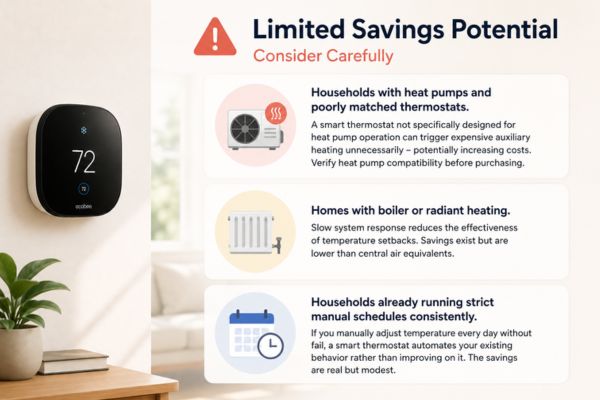
- Households with heat pumps and poorly matched thermostats. A smart thermostat not specifically designed for heat pump operation can trigger expensive auxiliary heating unnecessarily potentially increasing costs. Verify heat pump compatibility before purchasing.
- Homes with boiler or radiant heating. Slow system response reduces the effectiveness of temperature setbacks. Savings exist but are lower than central air equivalents.
- Households already running strict manual schedules consistently. If you manually adjust temperature every day without fail, a smart thermostat automates your existing behavior rather than improving on it. The savings are real but modest.
Smart Thermostat Comparison Which Saves the Most?
| Thermostat | Verified Savings | Best For |
|---|---|---|
| Ecobee SmartThermostat Premium | Up to 23% HVAC cost reduction (EPA-verified) | Multi-room homes, heat pump households, serious savers |
| Google Nest Learning Thermostat | 10–15% on heating and cooling | Google ecosystem, hands-off learning setup |
| Google Nest Thermostat | ~10% on heating and cooling | Budget-friendly smart thermostat entry point |
| Honeywell Home T9 | ~10–12% | Multi-room sensing, Alexa-primary households |
The Ecobee’s higher verified savings percentage comes primarily from its room sensor system SmartSensors detect occupancy and temperature in individual rooms, allowing the system to heat and cool only the spaces that are actually occupied. In a home where several rooms are regularly unoccupied, this makes a meaningful difference.
Frequently Asked Questions
Most US households save $130–$260 per year based on EPA-verified field study data a 15–23% reduction in HVAC costs. The EPA’s conservative ENERGY STAR baseline is ~$50/year; field studies from high-HVAC households in extreme climates show savings up to $400/year. Your result depends primarily on your current thermostat habits, your climate zone, and how well you configure the device.
Modestly. Programmable thermostats already capture the setback savings a smart thermostat adds geofencing (which handles schedule deviations), remote control, energy reporting, and demand response enrollment. If you consistently use your programmable thermostat’s schedule, a smart thermostat adds incremental savings of $50–$120/year rather than transformational savings.
Typically 8–16 months for most US households. Entry-level models like the Nest Thermostat (~$130) often pay back in under a year. Premium models like the Ecobee SmartThermostat (~$249) take slightly longer but save more annually. Utility rebates of $50–$100, available in many US states, accelerate payback significantly.
It depends. Apartments with individual HVAC systems (mini-splits, through-wall units, or individual forced-air) benefit from smart thermostat control the same way houses do. Apartments with centralized building HVAC (heat and cooling controlled by the building) have no thermostat to install. Check your apartment’s HVAC setup before purchasing.
Yes in specific scenarios. A heat pump paired with a non-heat-pump-compatible smart thermostat can trigger expensive auxiliary electric resistance heating unnecessarily. A smart thermostat set to maintain comfort 24/7 without any setback programming saves nothing. And a thermostat configured with too-aggressive setbacks in very cold climates can cause pipes to freeze during extended periods of extreme cold. Correct compatibility and configuration are essential.
The Ecobee SmartThermostat Premium has the highest EPA-verified savings rating (23% HVAC cost reduction) of any thermostat on the US market. The Google Nest Learning Thermostat delivers 10–15% savings with the most hands-off setup it learns your schedule automatically without manual programming. For most households, either delivers strong savings; the choice comes down to ecosystem preference and whether you want hands-on or hands-off setup.
The Bottom Line Do Smart Thermostats Really Save Money?
Yes with one condition: they have to be configured to do something.
A smart thermostat set to hold 70°F all day saves nothing over a standard thermostat. A smart thermostat with geofencing enabled, setback temperatures configured, and vacation mode set before every trip consistently delivers $130–$260 in annual savings for the average US household.
Smart thermostats are proven to reduce actual energy consumption through automation, learning your habits, and adjusting temperatures during peak usage times. The device doesn’t make the savings happen the automation does. That’s a distinction worth understanding before you buy.
The checklist before purchasing:
- Verify your HVAC system compatibility (especially for heat pumps)
- Check your utility’s rebate program $50–$100 may be waiting for you
- Confirm C-wire availability or adapter options for your chosen thermostat
- Commit to spending 20 minutes configuring geofencing and setback temperatures on day one
Done right, a smart thermostat is one of the highest-return energy investments a US household can make with a payback period under a year for most buyers.
Ecobee Smart Thermostat Premium: The Best Smart Thermostat for Most US Homes?

Let’s be honest. A thermostat isn’t exactly the most exciting thing you’re going to buy for your home. It’s not…
Smart Plugs: The Simple Energy Saver Most Homeowners Overlook
There’s a good chance something in your living room is costing you money right now. Not because it’s running because…
How Smart Thermostats Save Money: The Real Numbers (And When They Don’t)
Every smart thermostat says the same thing: install one and save money. The claims range from $50 a year to…