

Smart Home Connectivity Basics: Understanding WiFi, Zigbee, Z-Wave, and Matter
Understanding smart home connectivity basics can help homeowners choose the right devices and build a more reliable and efficient smart home system.
A smart home depends on reliable communication between devices. Whether you’re controlling lights, monitoring security cameras, or managing smart appliances, connectivity is what allows these devices to work together seamlessly.
Why Smart Home Connectivity?
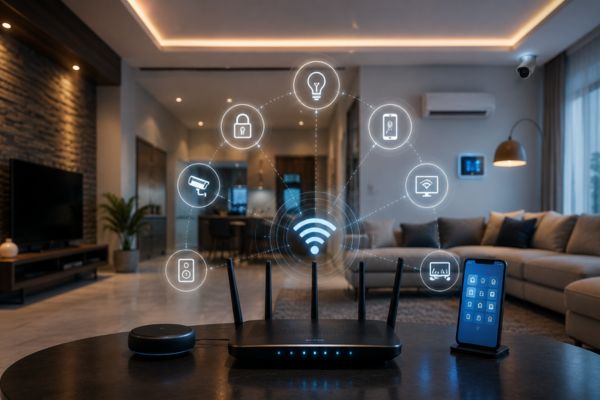
Connectivity enables smart devices to send and receive information. Without a communication method, devices cannot respond to commands, share data, or participate in automation routines.
The type of connectivity used can affect:
- Device performance
- Battery life
- Network reliability
- Automation speed
- Compatibility
Selecting the right connectivity option is essential for creating a stable smart home ecosystem.
Wi-Fi Connectivity
Wi-Fi is the most common smart home connection technology.
Many devices connect directly to a home’s wireless router, allowing users to control them through mobile apps and cloud services.
Advantages of Wi-Fi
- Easy setup
- No dedicated hub required
- Wide availability
- Supports high-bandwidth devices
Best Uses
Wi-Fi works particularly well for:
- Smart cameras
- Video doorbells
- Smart TVs
- Smart appliances
Limitations
A large number of Wi-Fi devices can increase network congestion and impact performance.
Bluetooth Connectivity
Bluetooth provides short-range wireless communication between devices.
Some smart home products use Bluetooth during initial setup, while others rely on it for direct local control.
Advantages
- Low power consumption
- Simple device pairing
- No internet connection required
Limitations
- Limited range
- Less suitable for whole-home automation
Zigbee Connectivity

Zigbee is a low-power wireless protocol designed specifically for smart home devices.
It creates a mesh network, allowing devices to relay signals between one another.
Advantages
- Excellent battery efficiency
- Reliable communication
- Supports many connected devices
Common Devices
- Smart bulbs
- Motion sensors
- Smart switches
- Door sensors
Z-Wave Connectivity
Z-Wave is another popular smart home protocol that uses mesh networking technology.
Like Zigbee, devices communicate with neighboring devices to extend coverage throughout the home.
Advantages
- Strong reliability
- Reduced interference
- Good range
Common Applications
- Smart locks
- Security systems
- Sensors
- Home automation devices
Thread Connectivity
Thread is a newer networking protocol built specifically for smart homes.
It creates self-healing mesh networks that can automatically reroute communications if one device becomes unavailable.
Benefits
- Fast response times
- High reliability
- Energy efficiency
- Enhanced security
Thread is becoming increasingly important as more manufacturers adopt modern smart home standards.
What Is Matter?
Matter is not a wireless protocol itself. Instead, it is a universal smart home standard designed to improve compatibility between devices and ecosystems.
Matter works with technologies such as:
- Wi-Fi
- Ethernet
- Thread
Benefits of Matter
- Easier device setup
- Better interoperability
- Reduced compatibility issues
- Greater consumer flexibility
Matter allows devices from different brands to communicate more effectively within the same smart home.
Choosing the Right Connectivity Option
The ideal connectivity method depends on your smart home goals.
| Connectivity | Best For | Strength |
|---|---|---|
| Wi-Fi | Cameras, appliances | High bandwidth |
| Bluetooth | Direct control | Simplicity |
| Zigbee | Sensors, lighting | Low power |
| Z-Wave | Security devices | Reliability |
| Thread | Modern smart homes | Mesh networking |
| Matter | Cross-brand compatibility | Interoperability |
Many homeowners use multiple connectivity technologies simultaneously to maximize performance and flexibility.
Building a Reliable Smart Home Network
To ensure stable performance:
- Use a modern router
- Keep firmware updated
- Avoid overcrowding Wi-Fi networks
- Position hubs centrally
- Choose Matter-compatible devices when possible
A well-designed network provides faster responses and more dependable automation.
Conclusion
Understanding smart home connectivity basics is essential for building an efficient and reliable connected home. Wi-Fi, Bluetooth, Zigbee, Z-Wave, Thread, and Matter each serve unique purposes and offer different advantages. By selecting the right combination of technologies, homeowners can create a smart home ecosystem that delivers convenience, security, and seamless automation for years to come.