


Let’s be honest. A thermostat isn’t exactly the most exciting thing you’re going to buy for your home.
It’s not a new TV. It doesn’t make coffee. It probably won’t impress your friends at dinner.
But a good smart thermostat can quietly save you money while keeping your home comfortable — and that’s where the Ecobee SmartThermostat Premium gets interesting.
I’ve been looking at what the Ecobee Premium actually offers, and there are quite a few things I like about it. But there are also a few things I’d think about before spending around $250 or more.
So let’s keep it simple.
My Quick Take
| Category | Rating |
| Energy Savings | 4.8/5 |
| SmartSensor | 4.7/5 |
| Design | 4.5/5 |
| Smart Home Features | 4.9/5 |
| Air Quality | 4.3/5 |
| Installation | 4.6/5 |
| Value | 4.6/5 |
What’s in the Box?
Ecobee gives you quite a lot:
- Ecobee SmartThermostat Premium
- One SmartSensor
- Power Extender Kit
- Trim plate
- Wire labels
- Installation guide
- Mounting hardware
Design and Display
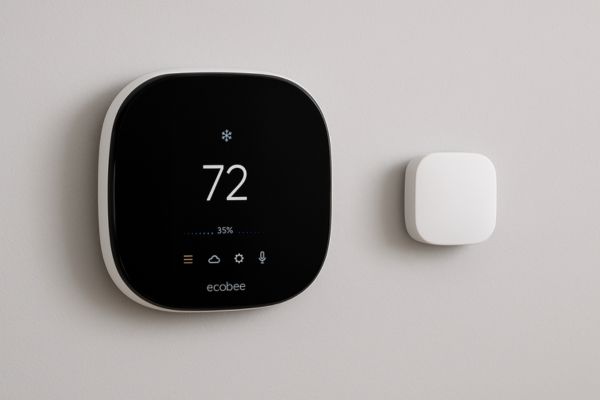
The Ecobee Premium looks pretty good.
It has a large color touchscreen that’s easy to read, and you can see the temperature, humidity, weather and other information without opening the app.
The metal edge also makes it look more premium than a basic plastic thermostat.
And yes, it is still a thermostat.
But at least it’s a nice-looking thermostat.
The touchscreen is also easy enough to use for everyday adjustments. You don’t need your phone just to turn the temperature up a couple of degrees..
What If I Don’t Have a C-Wire?
This is good news.
The Ecobee Premium comes with a Power Extender Kit, or PEK.
This can allow the thermostat to work with compatible systems that don’t have a C-wire.
The PEK is installed near your furnace or air handler.
It’s an extra step, but it can save you from having to install a new wire.
Just check compatibility before buying.
The SmartSensor: My Favorite Feature
This is where I think the Ecobee Premium really earns some of its extra cost.
The SmartSensor is a small wireless sensor that you place in another room.
It measures:
- Temperature
- Occupancy
Let’s say your thermostat is in the hallway.
The hallway is 70°F.
But your bedroom feels like you’re sleeping inside a refrigerator.
Without another sensor, the thermostat doesn’t really know what’s happening in your bedroom.
Put a SmartSensor there, and Ecobee gets another temperature reading.
It can then use that information when managing your home’s heating and cooling.
This is particularly useful in:
- Two-story homes
- Larger homes
- Homes with hot bedrooms
- Homes with cold basements
- Homes where the thermostat is in a hallway
For me, this is much more useful than having a thermostat that can tell me the weather while I’m already holding a phone that can tell me the weather.
Check compatibility at ecobee.com/compatibility before purchasing. The 5% of incompatible systems typically include high voltage systems (baseboard electric heat over 24V), some older two wire systems, and certain proprietary HVAC configurations.
Energy Savings
Now we get to the important part.
Can it actually save money?
Ecobee says its smart thermostats can save up to 26% on heating and cooling compared with keeping your home at a constant 72°F.
But don’t assume you’re automatically going to save exactly 26%.
Your actual savings depend on things like:
- Where you live
- Your energy prices
- Your HVAC system
- How often you heat or cool your home
- Your home’s insulation
- How you configure the thermostat
So I wouldn’t buy this thermostat just because you see “26%” on the marketing material.
The real benefit comes from using the smart features properly.
eco+: The Energy-Saving Features
Ecobee’s eco+ system includes several ways to reduce energy use.
Time-of-Use
If your electricity company charges more during certain hours, Ecobee can adjust heating and cooling to avoid some of those expensive periods.
Geofencing
If everyone leaves the house, the thermostat can switch to an energy-saving mode.
When someone comes home, it can adjust again.
Pretty handy.
Basically, your thermostat can notice that everyone has left instead of sitting there thinking:
“Well… I guess they’re coming back eventually.”
Feels Like
Ecobee also considers humidity when managing comfort.
That’s useful because 75°F with high humidity can feel very different from 75°F on a dry day.
Don’t Forget About Rebates
Before paying full price, check your local utility company.
Some US utilities offer rebates for smart thermostats.
If you can get $50 or $100 back, suddenly that expensive thermostat doesn’t look quite as expensive.
Always check first.
Free money is one of the few things in life worth looking for.
Smart Home Integration
The Ecobee Premium works with several major smart-home systems:
- Amazon Alexa
- Google Home
- Apple HomeKit
- Samsung SmartThings
- IFTTT
That’s a big advantage if you have a mixed smart-home setup.
You don’t necessarily have to rebuild your entire smart home around one ecosystem.
Apple HomeKit
If you’re an Apple Home user, Ecobee is particularly interesting.
The thermostat and SmartSensors can work with HomeKit, which means you can use temperature and occupancy information in your automations.
For example, you could use occupancy information from a sensor as part of a lighting automation.
That’s pretty useful.
Built-In Alexa
Alexa is built into the thermostat.
You can ask it to change the temperature, control other smart devices, set timers, and more.
The microphone works well enough for normal voice commands.
The speaker, however, isn’t going to replace your nice Bluetooth speaker.
Think of it as:
“Alexa is conveniently here.”
Not:
“Congratulations, you’ve just bought a new music system.”
Smart Home Integration Best in Class
What About Air Quality?
The Premium can monitor:
- VOCs
- CO2
- Humidity
- Temperature
That’s useful information.
But there’s an important catch.
The thermostat mostly shows you the information.
It doesn’t automatically solve the problem.
So if the air quality gets worse, it isn’t going to magically open your windows and start cleaning the air.
It’s better to think of this as an extra monitoring feature rather than a complete air-quality solution.
If air quality is your main concern, I’d look at a dedicated air-quality monitor as well.
Built In Alexa Speaker
The built-in Alexa speaker functions as a full Echo device not just a thermostat with a voice command or two. Ask questions, control other smart home devices, set timers, play music via Spotify Connect, make Alexa announcements, and build Alexa routines that include thermostat control alongside lighting, locks, and cameras.
Pros include robust voice control via Alexa and a built-in Alexa speaker. Cons: the built-in speaker doesn’t sound great. The speaker is adequate for voice feedback and announcements it won’t replace a dedicated Echo speaker for music.
The Ecobee App
The Ecobee app is polished and shows detailed energy reports runtime hours, HVAC cycle frequency, system status, and monthly comparisons. The energy report is one of the most comprehensive of any smart thermostat it’s genuinely useful for identifying usage patterns and opportunities for additional savings.
The initial setup and configuration can feel overwhelming there are many settings, and the depth of eco+ configuration options rewards time spent but isn’t immediately intuitive. The app can feel overwhelming at first with extensive settings. After the initial learning curve (typically 1–2 weeks), most users report the app becomes an asset rather than a friction point.
Ecobee Premium vs. The Competition
Ecobee Premium vs. Google Nest Learning Thermostat (4th Gen)
| Ecobee SmartThermostat Premium | Nest Learning Thermostat (4th Gen) | |
|---|---|---|
| Price | ~249–284 | ~$280 |
| Display | 3.9-inch color touchscreen | 2.08-inch color display |
| Included sensor | Yes, SmartSensor in box | No (sold separately ~$40) |
| Built in speaker | Yes, Alexa | No |
| Air quality monitor | Yes (VOC, CO2, humidity) | No |
| Smart home | Alexa + Google + HomeKit + SmartThings | Alexa + Google Home (no HomeKit native) |
| Matter | No (in development) | Yes |
| Learning | Eco+ + schedule suggestions | Auto-learning from behavior |
| EPA savings | Up to 26% | 10–15% independently verified |
| Utility rebates | Wide availability | Wide availability |
Verdict vs. Nest: The two thermostats take slightly different approaches.
Nest focuses more on learning your routine automatically.
Ecobee gives you more control and puts more emphasis on room sensors and detailed settings.
If you’re heavily invested in Google Home and want Matter, Nest is worth considering.
If you use Apple HomeKit or want room sensors included, Ecobee becomes more interesting.
Ecobee Premium vs. Ecobee Enhanced
This is actually the comparison I’d pay close attention to.
The Ecobee Enhanced is cheaper, while still using the same eco+ energy-saving platform.
The Premium gives you more features:
| Ecobee SmartThermostat Premium | Ecobee SmartThermostat Enhanced | |
|---|---|---|
| Price | ~249–284 | ~189–219 |
| Energy savings | Same (eco+ platform identical) | Same |
| Included Smart Sensor | Yes | No ($40 extra) |
| Built in Alexa speaker | Yes | No |
| Air quality monitor | Yes | No |
| Radar occupancy | Yes | PIR (older technology) |
| HVAC compatibility | 95% (including complex heat pumps) | 95% (most systems) |
So you’re not necessarily paying extra for dramatically better energy savings. You’re paying for the additional features.
If you don’t need Alexa, air-quality monitoring, or the included SmartSensor, the Enhanced may make more sense.
Who Should Buy the Ecobee Premium?
I’d seriously consider it if:
Your home has uneven temperatures
If one bedroom is always hot and another room is freezing, the SmartSensor can be very useful.
You use Apple HomeKit
Ecobee’s HomeKit integration is one of its strongest features.
You want detailed energy information
If you enjoy looking at energy reports and trying to reduce your HVAC use, you’ll get plenty of information.
You use Alexa
Having Alexa built into the thermostat is convenient.
Who Doesn’t Really Need It?
You probably don’t need the Premium if:
You only want basic temperature control
If you just want to control your thermostat from your phone, cheaper options can do the job.
You’re trying to keep costs down
The Enhanced is worth checking out.
You want Matter
If Matter is important to you today, the Nest has an advantage.
You have a very simple home
If you have one HVAC zone and the thermostat already represents the temperature in your main living area, a SmartSensor may not be very useful.
Common Questions About the Ecobee Smart Thermostat Premium
Yes. Every Ecobee Premium includes the Power Extender Kit (PEK) in the box, which installs at your furnace or air handler control board and eliminates the need for a C wire. Installation takes an extra 10-15 minutes. If you’re uncertain about installing the PEK yourself, Ecobee offers a professional installation service or you can hire an HVAC technician for approximately $100.
Up to 32 SmartSensors can connect to a single Ecobee thermostat. One SmartSensor is included in the box; additional sensors cost approximately $40 each or $70 for a 2 pack. For whole-home coverage of a typical US home, 3-5 total sensors (including the thermostat’s own sensor) covers most configurations.
Yes, and it’s the best HomeKit thermostat integration available. Both the thermostat and SmartSensors appear as HomeKit accessories, enabling temperature and occupancy automations in Apple Home. The Ecobee is one of a small number of thermostats with genuine HomeKit support.
The energy savings are identical both run the same eco+ platform. The Premium adds an included SmartSensor (worth ~189 delivers the same HVAC efficiency at a lower price.
Most US households recover the cost through energy savings within 12-16 months. High-HVAC households in extreme climates (Texas, Florida, New England) typically see faster payback 8-12 months in some cases. Utility rebates of 50-100 (check ecobee.com/rebates) significantly accelerate the payback period.
Not as of July 2026. Ecobee has indicated Matter support is in development but has not announced a release timeline. The Google Nest Learning Thermostat (4th Gen) currently has Matter certification a meaningful consideration for buyers prioritizing future smart home compatibility.
What Could Be Better
This is the Ecobee Premium’s most notable gap in 2026. Competitor Nest Learning Thermostat already supports Matter Ecobee’s delayed implementation is a meaningful disadvantage for buyers planning around the Matter ecosystem standard.
The VOC and CO2 data is useful context, but the thermostat doesn’t act on it no automatic ventilation trigger, no integration with air purifiers. A feature that generates data without enabling action is only partially useful.
The depth of eco+ settings is genuinely useful once mastered, but the initial configuration experience is more demanding than the Nest’s minimal setup. First-time smart home buyers may find the learning curve steeper than expected.
Functional for Alexa voice interaction and announcements, but not a satisfying music speaker. If high quality audio matters for your thermostat location, pair with a separate Echo device rather than relying on the built-in speaker.
At 249–284 with no Matter support while the Nest offers Matter at $280, the price justification relies entirely on the SmartSensor, Alexa speaker, air quality monitor, and HomeKit integration quality all of which are real differentiators, but the absence of Matter is a genuine objection at this price.
Our Final Verdict: Is the Ecobee SmartThermostat Premium Worth It?
For most US homeowners: yes — with one important caveat.
For buyers who want the single most capable smart thermostat on the market, the Ecobee Premium justifies its price better than any competitor. The combination of EPA-verified 23–26% energy savings, the included SmartSensor for room-level comfort, best-in-class HomeKit integration, built-in Alexa, and the broadest HVAC compatibility in the category creates a package that no single competitor matches completely.
The Ecobee Smart Thermostat Premium earns its price tag real world results put average annual savings between $220 and $312. At a typical household savings of $260/year, a $249 purchase pays for itself in under a year — and delivers those savings every year after.
The caveat: If you’re deeply invested in Google Home and want Matter compatibility today, the [Nest Learning Thermostat Review →] makes the case for the competing option. If energy savings alone without the Smart Sensor and Alexa speaker are your only goal, the Ecobee Enhanced at $189 delivers identical savings at a lower price.
But if you want the most complete smart thermostat available in 2026, the Ecobee SmartThermostat Premium is it.