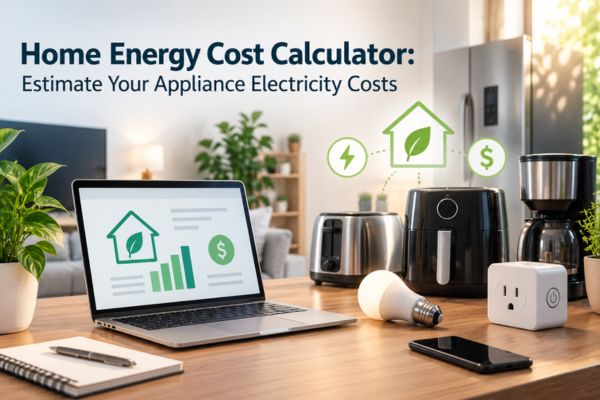

How much electricity does your TV, computer, or smart home device use? Our free Home Energy Cost Calculator helps you estimate how much an appliance costs to run each day, month, and year. You can also compare your current usage with a reduced daily schedule to see how much you could potentially save through smarter energy management.
Whether you’re building your first smart home or trying to reduce your electricity bill, understanding how much energy your devices consume is a useful place to start.
Home Energy Cost Calculator
Use our free calculator to estimate the electricity cost of an individual appliance. Enter its power consumption, daily usage, and your local electricity rate. You can also compare your current usage with a potential smart-home schedule.
Smart Home Energy Cost Calculator
Estimate your appliance electricity costs and potential savings from smart-home automation.
Your estimated energy costs
Energy usage breakdown
Estimates are based on the information entered and assume constant power consumption, a 30-day month, and 365 days per year. Actual electricity costs may vary. This calculator does not guarantee energy savings.
The calculator provides an estimate of your appliance’s daily energy consumption, monthly electricity cost, annual electricity cost, and potential savings from reducing its daily operating time.
Electricity consumption formula
Energy (kWh) =
Power (watts) × Usage time (hours) 1,000
To estimate the cost of running an appliance, multiply its energy consumption by your electricity rate:
Electricity cost = Energy consumption (kWh) × Electricity rate
For example, if a 100-watt television operates for 8 hours per day, its estimated daily energy consumption is:
100 × 8 1,000 = 0.8 kWh
If your electricity rate is $0.16 per kWh, the estimated daily cost is:
0.8 × $0.16 = $0.128
That is approximately $0.13 per day, or $3.84 over 30 days.
These figures assume the television continuously uses 100 watts while operating. Actual energy consumption may vary depending on the device, its settings, and standby behavior.
How to Use the Home Energy Cost Calculator
Our calculator is designed to be simple enough for beginners. Follow these steps to estimate the cost of running an appliance.
Start by entering the name of the device you want to evaluate. For example, you could enter:
- Smart TV
- Gaming computer
- Desk lamp
- Air purifier
- Smart speaker
- Desktop computer
The appliance name helps you identify the results. It does not affect the calculation.
Find the power consumption of your appliance in watts (W). You may find this information on the product label, power adapter, user manual, or manufacturer’s website.
For example, a device rated at 100 watts uses 100 watts of power when operating at its rated consumption.
Keep in mind that the rated wattage may not represent the device’s actual average consumption. Some appliances use more or less electricity depending on their operating mode.
Enter the price your utility charges per kilowatt-hour (kWh). You can usually find this information on your electricity bill or utility provider’s website.
For example, you might use an illustrative rate of $0.16 per kWh.
Your actual electricity rate may be different depending on your location, utility plan, time of use, and other charges. For a more accurate estimate, use the applicable energy rate from your bill.
Use the current usage slider to select approximately how many hours the appliance operates each day.
For example:
- A desk lamp might operate for 5 hours daily.
- A television might operate for 4 hours daily.
- A home office computer might operate for 8 hours daily.
- A device that remains active all day might operate for 24 hours daily.
The calculator uses your entered hours to estimate daily, monthly, and yearly energy costs.
The smart-home comparison allows you to enter a lower daily usage time. This represents a possible schedule after using automation to reduce unnecessary operating time.
For example, you could compare:cce
- Current usage: 8 hours per day
- Proposed schedule: 5 hours per day
The calculator estimates the difference in energy consumption and electricity costs between the two schedules.
Important: Smart-home automation does not automatically reduce the power consumption of every device. Potential savings depend on whether automation actually reduces operating time or prevents unnecessary energy use.
Example: How Much Does a 100 Watt Appliance Cost to Run?
Let’s look at a practical example using a 100-watt appliance.
Assume the following:
| Input | Example value |
|---|---|
| Appliance power | 100 watts |
| Current usage | 8 hours/day |
| Proposed smart home schedule | 5 hours/day |
| Electricity rate | $0.16/kWh |
| Monthly period | 30 days |
Current energy consumption
The appliance uses approximately:
100 × 8 1,000 = 0.8 kWh/day
Over 30 days:
0.8 × 30 = 24 kWh/month
Estimated monthly cost:
24 × $0.16 = $3.84
Energy consumption after the proposed schedule
If the appliance operates for 5 hours per day:
100 × 5 1,000 = 0.5 kWh/day
Over 30 days:
0.5 × 30 = 15 kWh/month
Estimated monthly cost:
15 × $0.16 = $2.40
Estimated savings
| Result | Estimate |
|---|---|
| Current monthly cost | $3.84 |
| Proposed monthly cost | $2.40 |
| Potential monthly savings | $1.44 |
| Potential annual savings | $17.52 |
How Smart Home Automation Can Help Reduce Energy Waste
Smart home technology can make it easier to manage when devices operate. The goal is not simply to add more connected devices, but to use automation where it provides a practical benefit.
Smart Plugs
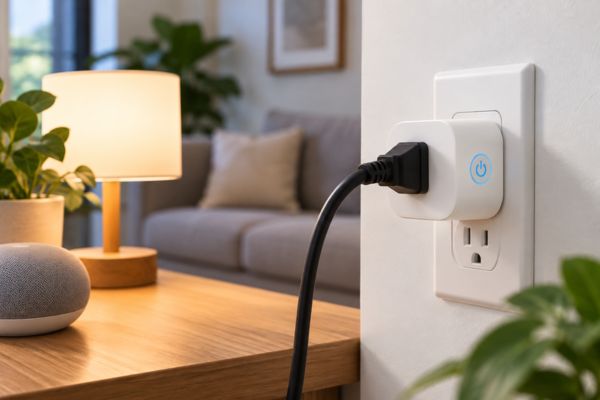
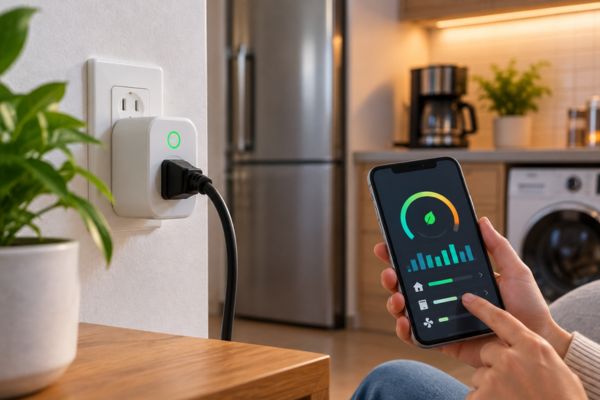
A smart plug can help you schedule compatible appliances to turn on or off at specific times. For example, you could use a smart plug to switch off a desk lamp or selected entertainment equipment when it is no longer needed.
Before using a smart plug, check that the appliance is compatible and that the plug is suitable for its electrical load. A smart plug cannot control every type of appliance safely or effectively.
Smart Lighting
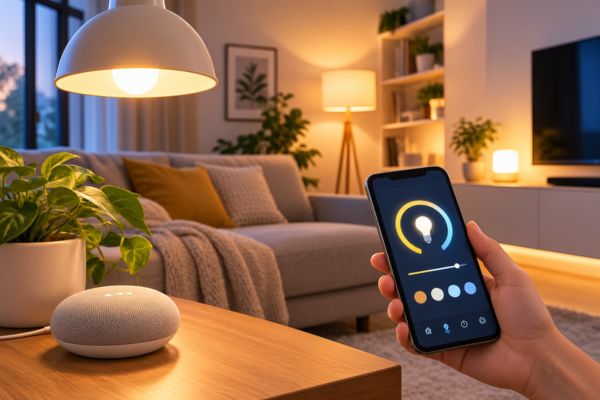
Smart bulbs and lighting routines can help prevent lights from being left on unnecessarily. You could create a schedule that turns off selected lights at bedtime or uses motion-based automation in suitable areas.
The potential savings depend on the lighting technology, wattage, operating time, and how much unnecessary use is avoided.
Smart Thermostats
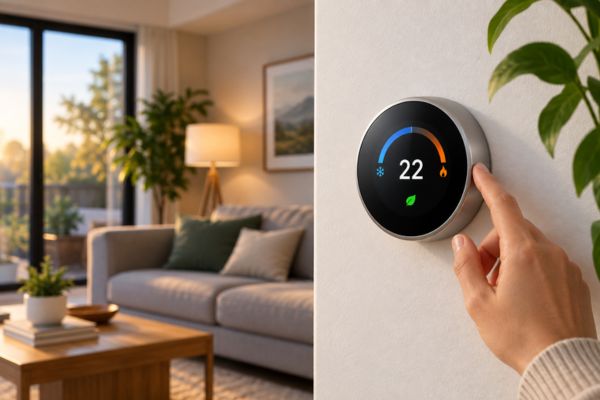
A smart thermostat can help manage heating and cooling schedules. Depending on the home’s climate, insulation, HVAC system, and household habits, adjusting temperature settings may reduce energy use.
However, actual savings vary significantly between homes. A thermostat calculator should be treated as an estimate rather than a guarantee.
Energy Monitoring Devices
Energy monitors and compatible smart plugs can help you understand how much electricity selected devices consume. Measuring actual usage can be more accurate than relying only on the wattage printed on a product label.
Monitoring can also help you identify devices that operate longer than necessary.
How to Get More Accurate Energy Cost Estimates
The calculator provides a useful starting point, but the accuracy of the result depends on the information you enter.
Check the actual power consumption
A device’s rated wattage may not represent its average power use. Some devices have different power requirements depending on brightness, workload, temperature, or operating mode.
For a more accurate estimate, consider using a suitable electricity usage monitor.
Use the correct electricity rate
Electricity prices vary between US states, utility providers, and rate plans. Some bills include fixed charges, taxes, delivery fees, and other costs that are not directly proportional to kilowatt-hours.
For an appliance-specific estimate, use the energy rate that best represents the applicable electricity charge.
Account for standby power
Some electronic devices continue to consume electricity when they appear to be switched off. This is often called standby power.
If standby consumption is significant, the actual cost may be higher than an estimate based only on active operating hours. The calculator’s basic version does not separately measure standby consumption.
Remember that usage can change
Your appliance may not operate for exactly the same number of hours every day. A longer or shorter operating schedule will affect your actual electricity costs.
For this reason, treat the calculator’s output as an estimate rather than an exact prediction of your utility bill.
Frequently Asked Questions
A home energy cost calculator is a tool that estimates how much electricity an appliance or device uses and how much that energy may cost. It typically uses the device’s wattage, operating time, and electricity rate to calculate an estimated cost.
Multiply the appliance’s wattage by the number of hours it operates, then divide by 1,000 to convert watt hours into kilowatt hours. Multiply the result by your electricity rate to estimate the cost.
For example, a 100 watt appliance used for 8 hours consumes 0.8 kWh per day.
At an illustrative electricity rate of $0.16 per kWh, a 100-watt appliance operating for 8 hours per day would cost approximately $3.84 over 30 days.
Your actual cost depends on the appliance’s power consumption, operating time, and electricity rate.
A smart plug may help reduce electricity use when it prevents compatible appliances from operating unnecessarily. For example, a scheduled smart plug could switch off a device that would otherwise remain on.
However, a smart plug itself does not guarantee energy savings. The result depends on the device, its operating behavior, and the automation schedule.
No. The calculator estimates the electricity cost of an individual appliance based on the information entered. It does not include all the appliances in your home, fixed utility charges, taxes, or other household electricity expenses.
No. Electricity rates vary by location, utility provider, rate plan, and other factors. Use the rate from your electricity bill or utility provider for a more relevant estimate.
Start Understanding Your Home’s Energy Use
Understanding how much electricity your devices consume is a useful first step toward building a more efficient smart home. By estimating appliance costs and comparing different usage schedules, you can identify opportunities to manage energy more effectively.
Try the AutomateVerge Home Energy Cost Calculator to estimate your appliance’s electricity costs and explore how a proposed smart-home schedule could affect your energy use.
For more smart home tips, explore our guides on [smart plugs], [smart lighting], [energy monitoring], and [smart-home automation].