
AI and Home Automation: Outlook How Intelligent Homes Are Redefining Smart Living
The concept of smart homes has evolved dramatically over the past decade. What started as simple remote controlled lights and app-based thermostats has now transformed into something far more powerful: AI home automation driven living environments that can think, learn, and adapt.
In 2026, we are no longer just talking about “home automation.” We are entering the era of intelligent living homes that understand behavior, anticipate needs, optimize energy, and actively contribute to comfort, safety, and sustainability.
Artificial Intelligence is no longer an add-on feature. It is becoming the brain of the modern home.
This article explores how AI is reshaping home automation in 2026, what trends are dominating the industry, real-world use cases, challenges, and what homeowners and businesses should prepare for next.
The Evolution of Home Automation: From Smart Devices to Intelligent Systems
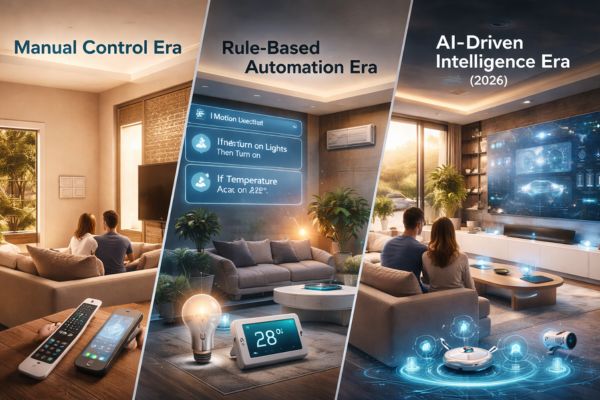
Home automation has gone through three major phases:
- Manual Control Era
Devices were controlled via switches, remotes, or basic apps.
- Rule Based Automation Era
Users created “if this, then that” routines:
- If motion is detected → turn on lights
- If temperature is above 28°C → turn on AC
- AI Driven Intelligence Era
Homes now:
- Learn from user behavior
- Predict needs before commands are given
- Make decisions based on context, habits, time, and environment
What Makes AI Different from Traditional Home Automation?
Traditional automation follows rules. AI based automation understands patterns, context, and intent.
Key Differences:
Traditional Automation:
- Works only when rules are defined
- Static and predictable
- Breaks easily when conditions change
AI-Powered Automation:
- Learns habits and routines automatically
- Adapts to lifestyle changes
- Understands context (weather, time, presence, behavior)
- Improves over time
In 2026, the most advanced smart homes are:
- Predictive → They act before you ask
- Context aware → They understand situations, not just commands
- Self optimizing → They continuously improve comfort and efficiency
The Biggest AI Smart Home Trends
1. Predictive and Self Learning Homes
Homes are now capable of learning patterns such as:
- When you wake up and go to sleep
- When rooms are usually occupied
- Preferred lighting, temperature, and music
- Weekly and seasonal routines
Instead of scheduling everything manually, the system builds its own behavioral model of the household.
Examples:
- The house prepares your workspace before you arrive.
- The AC cools the bedroom before you go to sleep without being told.
- Lighting adapts automatically based on mood, time, and activity.
2. AI for Energy Optimization and Cost Reduction
Energy efficiency is no longer just about smart devices it’s about smart decisions.
AI systems can now:
- Predict daily and monthly energy usage
- Optimize when to use or store energy
- Balance loads across devices
- Integrate with solar panels and battery systems
- Reduce peak hour consumption automatically
The result:
- Lower electricity bills
- Reduced carbon footprint
- More stable and efficient home energy ecosystems
The smart home is becoming an active energy manager, not just a passive consumer.
3. AI Powered Home Security
Security systems are no longer just motion detectors and cameras.
They can now:
- Recognize family members and frequent visitors
- Detect unusual behavior patterns
- Distinguish between normal and suspicious activities
- Identify potential threats before incidents happen
Examples:
- The system notices unusual movement patterns at night and alerts the homeowner.
- AI distinguishes between pets, humans, and unknown intruders.
- The house can automatically lock down specific zones when anomalies are detected.
This is the shift from reactive security to predictive protection.
4. Smarter Voice and Multimodal Assistants
Voice assistants in 2026 are no longer just “voice controlled remotes.”
They now:
- Understand context and follow-up commands
- Combine voice, gesture, and presence detection
- Remember preferences and ongoing tasks
- Interact more like digital companions than tools
Instead of saying:
“Turn off the living room lights.”
You can say:
“I’m going to sleep.”
And the home will:
- Turn off lights
- Lock doors
- Adjust temperature
- Activate security mode
All in one intelligent action.
5. AI for Health Monitoring and Well-Being
One of the fastest-growing areas of smart living in 2026 is health-focused home intelligence.
AI-powered homes can now:
- Monitor sleep quality
- Analyze air quality and humidity
- Detect unusual inactivity (especially for elderly residents)
- Optimize lighting for circadian rhythm
- Adjust environments to reduce stress and fatigue
The home is becoming a silent health assistant, not just a place to live.
6. From Smart Home to Smart Living Ecosystem
In 2026, the home automation is no longer isolated.
It is connected to:
- Electric vehicles
- Smart grids
- Smart cities
- Healthcare platforms
- Work from home ecosystems
Your home is becoming part of a larger intelligent living network.
Real World Use Cases of AI Home Automation
Here’s what AI driven homes are already doing:
- Automatically adjusting AC, lighting, and blinds based on weather and occupancy
- Reducing energy usage during peak tariff hours
- Detecting device issues before they break
- Learning which rooms you use most and optimizing comfort there
- Creating personalized “modes” for work, relax, sleep, or travel without manual setup
The key shift:
Homes are no longer programmed. They are trained.
The Role of AI in Sustainable and Eco-Friendly Homes
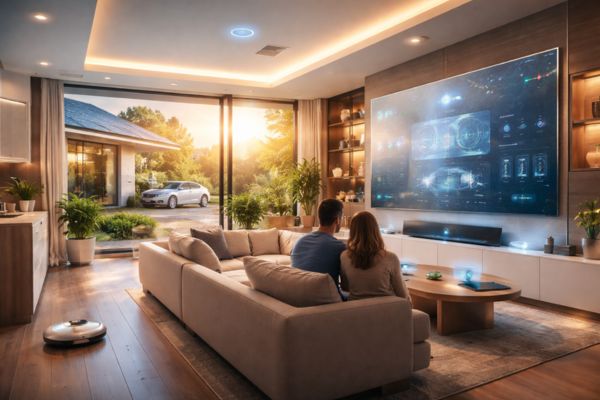
Sustainability is no longer optional it’s a design principle.
AI helps by:
- Forecasting energy needs
- Managing renewable energy sources
- Reducing waste and inefficiency
- Optimizing water usage
- Minimizing carbon emissions
In 2026, a truly smart home is also a responsible home.
Challenges and Concerns in AI Home Automation
Despite all the progress, there are still important challenges:
1. Privacy and Data Security
- AI needs data to learn
- More data means more responsibility
- Security and encryption are critical
2. Over Automation
- Not everything should be automated
- Bad AI design can reduce user control and comfort
3. Cost and Complexity
- Advanced systems still require investment
- Good design and integration matter more than just buying devices
4. Interoperability Issues
- Not all brands and ecosystems work well together
- Open standards are becoming more important than ever
What to Expect Beyond 2026
Looking ahead, we will likely see:
- Fully autonomous home management systems
- Emotion aware AI that responds to mood and stress
- Deeper integration with smart cities
- Homes that actively support mental and physical health
- Living spaces that adapt dynamically to life changes
How Homeowners and Businesses Should Prepare
If you want to future proof your home or property:
- Invest in good infrastructure (network, wiring, platforms)
- Choose ecosystems, not just devices
- Prioritize security and privacy
- Think in terms of systems, not products
- Design for adaptability, not just features
Also Read
Conclusion: From Smart Homes to Intelligent Living
In 2026, the smart home is no longer about gadgets.
It is about:
- Intelligence
- Adaptation
- Sustainability
- And truly human-centered living
We are moving from automated houses to intelligent living systems.
The question is no longer:
“Is my home smart?”
But:
“Is my home thinking with me?”