

Disclosure: Some links here are affiliate links. We may earn a commission at no extra cost to you. As an Amazon Associate, AutomateVerge earns from qualifying purchases. Read our affiliate disclosure.
Voice assistants have become an essential part of modern smart homes. Whether you want to control lights, play music, manage your calendar, or ask questions, AI-powered assistants make everyday tasks faster and more convenient. Alexa vs Google Assistant Comparison: Which Smart Assistant Should You Choose?
Among the most popular options, Amazon Alexa and Google Assistant continue to dominate the market. Both platforms support thousands of smart devices, offer natural voice interactions, and integrate with popular streaming services. However, they differ in search capabilities, smart home compatibility, ecosystem integration, and privacy features.
So, which one is the better choice?
This comprehensive Alexa vs Google Assistant comparison explores their features, strengths, weaknesses, and ideal use cases to help you make the right decision.
What Is Amazon Alexa?
Amazon Alexa is a cloud-based voice assistant developed by Amazon. It powers Echo smart speakers, Echo Show smart displays, Fire TV devices, and many third-party smart home products.
Alexa is particularly known for:
- Extensive smart home integration
- Thousands of Alexa Skills
- Excellent compatibility with Amazon services
- Powerful automation routines
Today, Alexa supports hundreds of thousands of compatible smart devices from various manufacturers.
What Is Google Assistant?
Google Assistant is Google’s intelligent voice assistant available on Android smartphones, Nest speakers, smart displays, tablets, TVs, and other compatible devices.
Google Assistant excels in:
- Natural language understanding
- Google Search integration
- Calendar and Gmail connectivity
- Accurate answers to general knowledge questions
Its strength comes from Google’s advanced search engine and AI technologies.
Alexa vs Google Assistant at a Glance
| Feature | Amazon Alexa | Google Assistant |
|---|---|---|
| Voice Recognition | Excellent | Excellent |
| General Knowledge | Good | Outstanding |
| Smart Home Devices | Excellent | Very Good |
| Automation | Excellent | Very Good |
| Search Accuracy | Good | Excellent |
| Music Streaming | Excellent | Excellent |
| Android Integration | Limited | Outstanding |
| Amazon Shopping | Outstanding | Basic |
| Routines | Advanced | Advanced |
| Multi-room Audio | Yes | Yes |
Voice Recognition and Accuracy
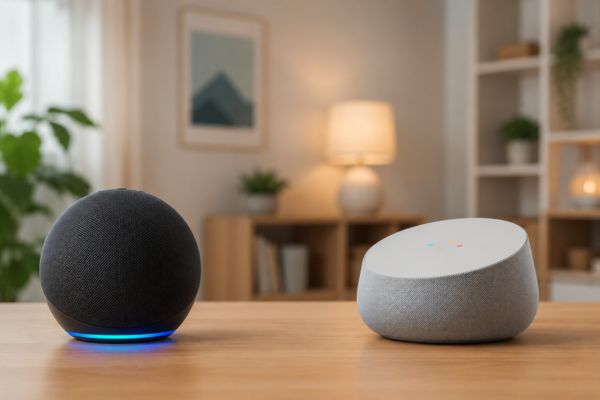
Both assistants understand natural speech remarkably well, but Google Assistant generally performs better with complex questions.
Alexa
Alexa handles common commands efficiently, such as:
- Turn off bedroom lights
- Set kitchen timer
- Play jazz music
- Create shopping lists
However, more complicated or conversational questions sometimes require more specific phrasing.
Google Assistant
Google Assistant leverages Google’s search capabilities to answer detailed questions naturally.
For example:
- Explain quantum computing simply
- What’s the weather this weekend?
- Find nearby restaurants
- Summarize today’s headlines
Its contextual understanding often feels more conversational.
Winner: Google Assistant
Smart Home Compatibility
This is where Alexa shines.
Amazon has invested heavily in smart home technology, resulting in exceptional compatibility with:
- Smart bulbs
- Smart plugs
- Security cameras
- Doorbells
- Smart locks
- Thermostats
- Robot vacuums
- Smart switches
Alexa also supports sophisticated automation routines involving multiple devices.
Google Assistant supports many of the same brands but may not provide every advanced feature available through Alexa.
Winner: Alexa
Music and Entertainment
Both assistants integrate with popular streaming services, including:
- Spotify
- YouTube Music
- Apple Music
- Amazon Music
- Pandora (region dependent)
Alexa Advantages
- Better Amazon Music integration
- Wide Echo speaker lineup
- Multi-room audio support
- Superior speaker pairing options
Google Assistant Advantages
- Better YouTube Music integration
- Chromecast support
- Excellent Android media controls
Overall, both provide a great entertainment experience.
Winner: Tie
Productivity Features
Voice assistants are no longer just for controlling lights. They also improve daily productivity.
Alexa Features
- Shopping lists
- Calendar reminders
- To-do lists
- Timers
- Announcements
- Household profiles
Google Assistant Features
- Google Calendar integration
- Gmail support
- Google Keep notes
- Google Tasks
- Maps integration
- Real-time traffic information
Android users often benefit more from Google’s ecosystem.
Winner: Google Assistant
AI and Conversation Quality
Recent AI improvements have significantly enhanced both assistants.
Google Assistant typically understands follow-up questions better and maintains conversational context more effectively.
For example:
User:
“Who invented the telephone?”
Assistant:
“Alexander Graham Bell.”
User:
“When was he born?”
Google Assistant usually understands that “he” refers to Alexander Graham Bell without requiring repetition.
Alexa has improved considerably but occasionally asks users to restate context.
Winner: Google Assistant
Privacy and Security
Privacy has become increasingly important when choosing a smart assistant.
Both Alexa and Google Assistant offer:
- Microphone mute buttons
- Voice history deletion
- Two-factor authentication
- Secure account management
- Privacy dashboards
Amazon places more emphasis on customizable privacy controls, while Google integrates privacy management into its broader account settings.
Regardless of your choice, voice recordings periodically and adjusting privacy settings is recommended.
Winner: Tie
Device Ecosystem
Choose Alexa If You Already Use
- Amazon Echo
- Fire TV
- Ring Doorbell
- Blink Cameras
- Amazon Shopping
Alexa integrates seamlessly with Amazon’s ecosystem.
Choose Google Assistant If You Already Use
- Android phones
- Google Pixel
- Google Calendar
- Gmail
- Google Photos
- Google Home
- Chromecast
Google Assistant offers a more unified experience for users invested in Google’s services.
Pricing
The assistants themselves are free, but you’ll need compatible hardware.
Amazon Alexa Devices
- Echo Pop
- Echo Dot
- Echo
- Echo Studio
- Echo Show
Amazon frequently discounts Echo devices during major sales.
Google Assistant Devices
- Nest Mini
- Nest Audio
- Nest Hub
- Nest Hub Max
Pricing is generally competitive, with entry-level smart speakers available at affordable prices.
Winner: Tie
Alexa Pros and Cons
Pros
- Excellent smart home compatibility
- Large ecosystem of compatible devices
- Powerful automation routines
- Wide selection of Echo products
- Strong Amazon integration
Cons
- Search results are not as comprehensive as Google’s
- Some advanced features depend on Amazon services
- Conversational AI can feel less natural
Google Assistant Pros and Cons
Pros
- Superior search accuracy
- Excellent natural language processing
- Outstanding Android integration
- Better contextual conversations
- Strong productivity tools
Cons
- Slightly fewer smart home automation options
- Smaller smart speaker lineup
- Best experience requires Google services
Which Assistant Is Best for You?
Choose Amazon Alexa if you:
- Own multiple smart home devices
- Want advanced home automation
- Frequently shop on Amazon
- Prefer extensive smart home compatibility
Choose Google Assistant if you:
- Use Android daily
- Rely on Google Calendar and Gmail
- Want better voice search
- Prefer more natural conversations
Ultimately, the best assistant depends on your existing devices and daily habits.
Frequently Asked Questions
Is Alexa better than Google Assistant?
Alexa is generally better for smart home automation and device compatibility, while Google Assistant excels in search accuracy, contextual conversations, and Android integration.
Which voice assistant is more accurate?
Google Assistant is usually more accurate when answering complex questions because it leverages Google’s powerful search technology.
Can Alexa and Google Assistant control the same smart devices?
Yes. Many popular smart home brands support both platforms, although certain advanced features may be available on only one ecosystem.
Which assistant offers better smart home automation?
Alexa typically provides more flexible automation options through advanced routines and broader smart device support.
Is Google Assistant free?
Yes. Google Assistant is free to use on compatible devices, although you will need supported hardware such as Android phones or Google Nest speakers.
Final Verdict
The competition between Alexa and Google Assistant remains close, but each platform excels in different areas.
If your priority is building a highly connected smart home with extensive automation, Amazon Alexa remains the stronger option thanks to its broad device compatibility and powerful routines.
If you value natural conversations, fast and accurate answers, and seamless integration with Android and Google services, Google Assistant is the better choice.
Before making a decision, consider the devices you already own and the ecosystem you use every day. Choosing the assistant that best fits your lifestyle will provide the smoothest and most rewarding smart home experience.