

The Future of Matter in Smart Homes: The New Standard for Connectivity and Control
Disclosure: Some links here are affiliate links. We may earn a commission at no extra cost to you. As an Amazon Associate, AutomateVerge earns from qualifying purchases. Read our affiliate disclosure.
The smart home industry has grown rapidly over the last decade. From smart lights and thermostats to door locks and security cameras, homeowners now have access to hundreds of devices that promise comfort, efficiency, and automation. But as the market expanded, a major problem emerged: fragmentation.
Different brands use different platforms, apps, and protocols. Some devices work only with Google Home, others with Apple HomeKit or Amazon Alexa. Many require separate hubs, separate accounts, and complicated setup processes. Instead of feeling “smart,” many homes feel confusing and difficult to manage.
This is exactly the problem that Matter was created to solve.
Matter is a new smart home standard designed to unify the entire ecosystem making devices from different brands work together seamlessly, reliably, and securely. And in the coming years, Matter is set to become the foundation of connectivity and control in modern smart homes.
In this article, we’ll explore what Matter is, why it exists, how it works, how it compares to older protocols, and why it represents the future of smart home connectivity.
What Is Matter?

Matter is a universal, open-source smart home connectivity standard developed by the Connectivity Standards Alliance (CSA) and supported by industry giants such as Apple, Google, Amazon, Samsung, and many others.
In simple terms:
Matter is a common language that allows smart home devices from different brands and ecosystems to work together.
With Matter, a smart bulb, switch, or lock can:
- Work across multiple platforms (Google Home, Apple Home, Alexa, etc.)
- Be controlled locally without relying on the cloud
- Be easier to set up and more reliable to use
Instead of replacing existing ecosystems, Matter connects them.
The goal is simple:
Make smart homes truly smart, not complicated.
Why Matter Was Created
1. The Fragmentation Problem
Today’s smart home ecosystem is divided by:
- Different apps
- Different hubs
- Different protocols
- Different compatibility rules
A device that works with one platform often doesn’t work with another. Users are forced to:
- Choose ecosystems early
- Buy devices only from certain brands
- Deal with complex workarounds and integrations
This creates vendor lock in and a poor user experience.
2. Setup Is Too Complicated
Many smart home devices today require:
- Multiple apps
- Cloud accounts
- Complicated pairing steps
- Troubleshooting network issues
For mainstream users, this is a huge barrier to adoption.
3. Reliability and Speed Issues
Cloud-dependent devices:
- Stop working when the internet is down
- Have delays in response
- Raise privacy and security concerns
Matter’s Mission
Matter was created to:
- Unify the ecosystem
- Simplify setup
- Improve reliability
- Increase security
- Enable true cross-brand compatibility
How Matter Works in Smart Homes
1. Matter Is IP Based
Unlike older protocols, Matter is built on Internet Protocol (IP) the same foundation used by the internet and local networks.
This means Matter devices can run over:
- WiFi
- Ethernet
- Thread (a low power mesh network for smart devices)
2. Local First Control
Matter is designed to work locally inside your home network.
Benefits:
- Faster response times
- Devices still work even if the internet is down
- Better privacy
- More reliable automations
3. Simple Pairing and Setup
Matter uses standardized onboarding methods:
- QR codes
- Numeric setup codes
- Secure device commissioning
This makes adding new devices much easier and more consistent across brands.
4. Multi Admin Support
One of Matter’s most powerful features is multi admin support.
This means:
- One device can be connected to multiple ecosystems at the same time
- For example: the same smart lamp can be controlled by both Google Home and Apple Home without hacks or reconfiguration
The Role of Thread, WiFi, and Ethernet
Matter is not a replacement for network technologies it works on top of them.
- WiFi: Used for higher bandwidth devices like cameras and displays
- Ethernet: Used for hubs and controllers
- Thread: Used for low-power devices like sensors, switches, and bulbs
Thread creates a fast, reliable, self healing mesh network inside your home, and Matter uses it as one of its main transport layers.
Matter vs Older Smart Home Protocols
Matter vs Zigbee
Zigbee:
- Requires a hub
- Works well, but fragmented by vendor implementations
- Not IP-based
Matter:
- IP based
- Directly compatible with modern networks
- Standardized across brands
Matter vs Z-Wave
Z-Wave:
- Proprietary technology
- Reliable but limited ecosystem
- Requires specific hubs
Matter:
- Open standard
- Backed by all major platforms
- Designed for the future internet-based infrastructure
Matter vs WiFi Devices
Traditional Wi-Fi devices:
- Often cloud-dependent
- Each brand uses its own app
- Poor interoperability
Matter over Wi-Fi:
- Local control
- Unified standards
- Cross platform compatibility
Important Clarification
Matter does not necessarily replace Zigbee or Z-Wave overnight. Instead, it acts as a unifying application layer that brings consistency and interoperability to the ecosystem.
FaQ
Benefits of Matter for Smart Home Users
1. True Interoperability
Buy devices based on:
- Quality
- Price
- Design
Not based on:
- Ecosystem lock-in
2. Easier Setup
- One consistent pairing experience
- No more juggling multiple apps
- Fewer technical headaches
3. Better Reliability
- Local control
- Faster response times
- Less dependency on cloud services
4. Better Security
Matter includes:
- Device authentication
- Encrypted communication
- Secure onboarding
Security is built into the standard, not added later.
5. Future Proof Smart Homes
With Matter:
- Your devices won’t become obsolete when you change platforms
- Your smart home becomes more modular and flexible
Benefits of Matter for the Smart Home Industry
1. Standardization
Manufacturers no longer need to:
- Build different versions for different ecosystems
- Maintain multiple integrations
2. Faster Innovation
Developers can:
- Focus on features and quality
- Not waste time on compatibility engineering
3. Healthier Ecosystem
- More competition
- Better products
- Lower prices
- More consumer choice
Current State of Matter Adoption
Matter is already supported by:
- Apple Home
- Google Home
- Amazon Alexa
- Samsung SmartThings
Many brands are:
- Releasing native Matter devices
- Updating existing devices via firmware
Device categories currently include:
- Lights
- Switches
- Plugs
- Sensors
- Locks
- Thermostats
- Media devices
The ecosystem is expanding with every new version of the standard.
The Future of Smart Homes with Matter
In the next 3-5 years, we will see:
1. Truly Plug and Play Smart Homes
- Buy device
- Scan code
- It just works
2. Ecosystem Agnostic Homes
Homes will no longer be:
- “Google homes”
- “Apple homes”
- “Alexa homes”
They will simply be smart homes.
3. More Local Intelligence
- More automations running locally
- Faster, more reliable behavior
- Less cloud dependency
4. More Modular Systems
You’ll be able to:
- Replace platforms
- Change hubs
- Upgrade systems
Without rebuilding your entire setup.
How Matter Strengthens the Connectivity & Control Pillar
Connectivity & Control is about:
- Unified management
- Seamless communication
- Reliable operation
- Centralized orchestration
Matter becomes the foundation layer that makes all of this possible by:
- Standardizing communication
- Removing ecosystem barriers
- Enabling true cross-platform control
- Making smart homes simpler, faster, and more reliable
In short:
Matter turns fragmented smart homes into cohesive systems.
Conclusion: Matter Is the Missing Piece
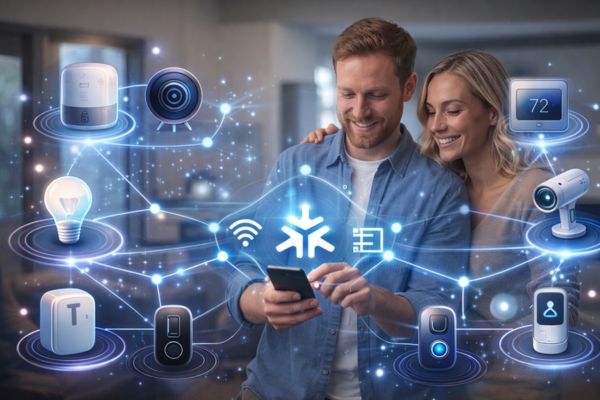
For years, smart homes have been powerful but messy.
Matter changes that.
It doesn’t just improve devices it fixes the entire ecosystem:
- Simpler setup
- Better reliability
- Real interoperability
- True user freedom
Matter is not just another protocol. It is the future foundation of smart home connectivity and control.
And as adoption grows, smart homes will finally become what they were always meant to be:
Simple, seamless, and truly smart.