
Smoke and CO Detectors Essential for Every Home
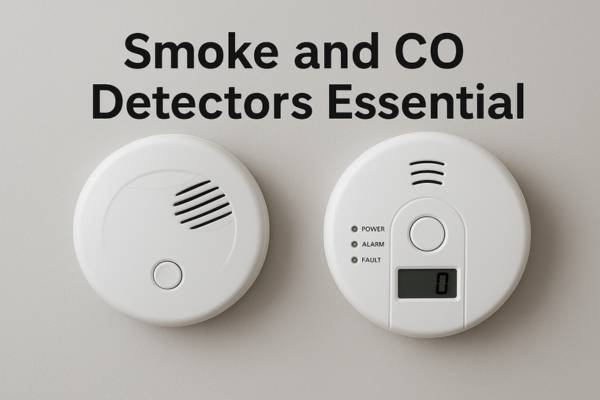
When people talk about making their homes safer, the conversation usually revolves around intruders, smart locks, or maybe a camera at the front door. But the truth is, the biggest threats aren’t always visible. Smoke and CO Detectors Essential for every home because fire and carbon monoxide (CO) spread silently inside, often without warning.
Installing smoke and CO detectors is one of the simplest and most effective steps you can take to protect your family. These devices are inexpensive, easy to set up, and work quietly in the background until you need them most.
The Dangers of Fire and Carbon Monoxide
House fires remain a leading cause of accidental death worldwide. According to the U.S. Fire Administration, residential fires account for more than 360,000 incidents every year in the U.S. alone, resulting in thousands of deaths and billions of dollars in property loss. A fire can double in size every minute, and the smoke it produces is often more deadly than the flames. Thick black smoke can disorient you, block escape routes, and cause suffocation in just a few breaths.
Carbon monoxide (CO) is equally dangerous. It’s called the “silent killer” because it’s completely invisible—you can’t see it, smell it, or taste it. Common household appliances like furnaces, water heaters, wood stoves, or even a car left running in an attached garage can emit CO. The CDC estimates that at least 430 people die and 50,000 are hospitalized every year in the U.S. because of accidental CO poisoning.
Both fire and CO share one crucial detail: you may not know you’re in danger until your body reacts or until an alarm goes off. That’s why Smoke and CO Detectors Essential in every household.
How Detectors Save Lives
Smoke and CO detectors buy you what’s most precious in an emergency: time. Time to wake up in the middle of the night, get your children out of bed. Time to call 911 before the situation escalates.
The National Fire Protection Association (NFPA) reports that the risk of dying in a home fire is cut in half when working smoke alarms are present. Similarly, most fatal CO incidents occur in homes without a functioning detector.
In other words, detectors are not gadgets they’re life-saving guardians that stand watch 24/7.
How Smoke & CO Detectors Work
Smoke Detection Basics
Smoke detectors typically use one of two sensing technologies:
- Ionization detectors: Detect fast moving, flaming fires (like grease fires in the kitchen).
- Photoelectric detectors: Detect slow, smoldering fires (like a cigarette left on a couch).
Many modern alarms combine both technologies for maximum protection. Experts recommend dual-sensor alarms to cover all fire scenarios.
Carbon Monoxide Detection Basics
CO detectors usually rely on electrochemical sensors, which react with CO gas and trigger an alarm at dangerous levels. Some models display CO levels on a digital screen, helping you monitor exposure before it becomes an emergency.
Combined Smoke + CO Detectors
For convenience, many brands now offer two in one units. These reduce clutter, simplify installation, and ensure that no part of your home is left unprotected. However, in larger homes, you may still need multiple detectors strategically placed.
Key Benefits of Smoke and CO Detectors Essential
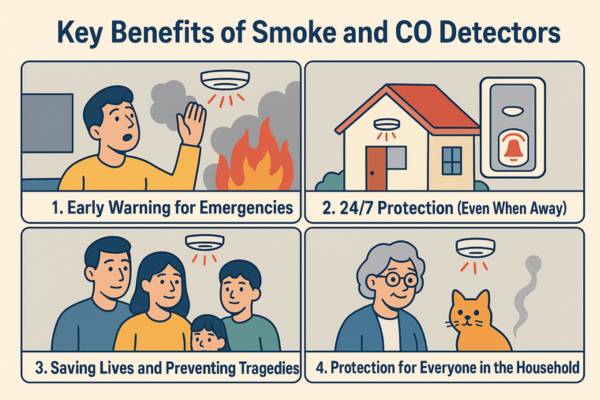
When you step back and think about it, detectors are such small devices but their impact is enormous. They don’t just sit on your ceiling or wall; they stand watch over your family, your pets, and your home 24/7. Here’s a deeper look at the many ways they benefit you.
1. Early Warning for Emergencies
Imagine it’s 2 a.m. You’re sound asleep, your phone is on silent, and outside, the neighborhood is quiet. Suddenly, a small electrical fire sparks in your living room. Without a smoke alarm, the fire grows unchecked, filling the room with smoke long before flames reach your bedroom. By the time you wake up naturally, it could be too late.
With a detector, the alarm would sound as soon as smoke particles are detected. That early warning gives you valuable minutes to gather your loved ones, follow your escape plan, and call emergency services.
In emergencies, minutes matter. Fires can double in size every 60 seconds. A CO leak can quietly poison you as you sleep. Detectors give you time—and time is survival.
2. 24/7 Protection (Even When You’re Away)
Life is busy. Families travel, kids go to school, parents commute to work. But just because you’re not home doesn’t mean your house is safe. Fires caused by faulty wiring or appliances can start at any time. CO leaks from furnaces or water heaters don’t wait until you’re home.
With detectors, your home is protected around the clock. Pair them with smart technology, and you’ll even get notifications on your phone no matter where you are. This peace of mind means you don’t have to constantly worry when leaving pets at home, when your teenager is home alone, or when you’re on vacation.
3. Saving Lives and Preventing Tragedies
The most powerful benefit is the simplest: detectors save lives.
According to the NFPA, nearly three out of five fire deaths occur in homes without working smoke alarms. That statistic alone shows the massive difference detectors make. For CO, the CDC reports that hundreds of lives are lost each year simply because there was no detector to alert occupants.
Behind these numbers are real families. There are countless stories where detectors saved parents, children, and even entire apartment buildings because one alarm triggered quick evacuation. It’s not an exaggeration: without them, those people likely wouldn’t be alive today.
4. Protection for Everyone in the Household
Detectors don’t just protect you they protect everyone you care about.
- Children may not wake up quickly to strange smells or mild headaches caused by CO, but they will wake up to a loud alarm.
- Older adults often have slower response times, but early warnings give them more time to escape safely.
- Pets are especially vulnerable because they can’t understand danger cues alarms give you the chance to rescue them before it’s too late.
When you think about detectors, you’re not just thinking about yourself—you’re safeguarding every living being in your home.
5. Compliance with Laws and Insurance
Many regions legally require smoke and CO detectors in residential homes, especially rentals. For landlords, failing to install them could result in legal action or liability in case of tenant injury. For homeowners, detectors often influence insurance claims. Some insurers even offer discounts on premiums if you have updated alarms installed.
So beyond safety, detectors can protect your wallet and legal standing.
6. Reducing Property Damage
The sooner a fire is detected, the sooner firefighters can respond. That means less destruction and lower repair costs. Even if everyone escapes unharmed, a house fire can wipe out belongings, family heirlooms, and months of stability. Detectors minimize this risk by ensuring fires are caught at the earliest possible stage.
7. Peace of Mind You Can’t Put a Price On
Finally, detectors provide something intangible but invaluable: peace of mind. You can sleep more soundly at night knowing that your family is protected. You can leave for work without that nagging fear that something might go wrong while you’re gone.
When it comes to safety, peace of mind isn’t just comfort it’s freedom from worry. That’s what detectors give you.
Smart Smoke & CO Detectors: The Next Step
Technology has made detectors smarter, easier to maintain, and far more effective than older models.
Connectivity to Phones & Smart Hubs
Smart detectors connect to Wi-Fi or Bluetooth, sending instant alerts to your phone if something’s wrong. Imagine being at work and receiving a notification that there’s smoke in your kitchen you can act before it becomes catastrophic. Integration with smart hubs like Google Home or Amazon Alexa also allows voice announcements across your home.
Extra Features: Battery Alerts, Voice Alerts, Integration
- Battery alerts: Instead of annoying chirps at 3 a.m., smart detectors send a phone alert when it’s time to replace a battery.
- Voice alerts: Instead of a generic alarm, some detectors speak: “Smoke detected in the kitchen.” This clear information helps you respond faster.
- Integration: Advanced models can connect with security systems, smart locks, or even HVAC systems. For example, they can automatically shut down air circulation to slow the spread of smoke.
Smart detectors aren’t just about convenience they can literally save lives by reducing confusion and response time.
Common Myths & Mistakes
Despite overwhelming evidence, myths and misconceptions still cause many households to remain under-protected.
“I Don’t Need Both Smoke & CO Detectors”
This is one of the most dangerous assumptions. Smoke alarms do not detect carbon monoxide, and CO detectors cannot detect smoke. They are designed for different hazards. To stay safe, you need both—or a combination unit.
“Traditional Detectors Are Enough”
Traditional detectors are valuable, but they have limitations. Batteries die, sensors age, and they can’t notify you if you’re not home. Smart detectors address these weaknesses, making them worth the investment, especially for families who travel frequently or live in larger homes.
Best Practices for Home Safety
Installing detectors is a crucial step but proper placement, maintenance, and testing make all the difference.
Where to Place Smoke & CO Detectors
- Smoke detectors should be placed:
- Inside every bedroom.
- Outside each sleeping area (like hallways).
- On every level of the home, including basements and attics.
- CO detectors should be placed:
- Near bedrooms, so alarms wake sleeping occupants.
- On every level of the home.
- Near (but not directly next to) fuel-burning appliances.
Avoid kitchens and bathrooms for CO detectors steam and humidity can cause false alarms.
How Often to Test & Replace Them
- Test detectors monthly by pressing the test button.
- Replace batteries every 6–12 months, unless your model has a sealed 10-year battery.
- Replace smoke detectors every 10 years and CO detectors every 5–7 years.
A worn-out detector is almost as bad as having none at all.
FAQ: Smoke & CO Detectors Explained
Experts agree that Smoke and CO Detectors Essential for reducing fire risks and preventing carbon monoxide emergencies in modern homes.
Smoke and CO Detectors Essential: Final Thoughts
Home safety often feels overwhelming. There’s so much to consider: locks, cameras, security systems, emergency kits. But when you strip it down, safety is about protecting your family from the most immediate, life-threatening risks. Fire and carbon monoxide top that list and detectors are your best defense.
The truth is, these devices are small investments with life-changing impact. A standard smoke or CO detector costs less than a family dinner at a restaurant. A smart detector with advanced features may cost a little more, but compared to the value of your family’s lives and your entire home, the cost is negligible.
Think of detectors as silent guardians:
- They don’t demand attention, except for the occasional test or battery change.
- They don’t require expensive monitoring fees.
- They’re always there, always ready, even when you’re not.
If you take just one action after reading this article, let it be this: walk through your home today and check your detectors. Are they installed in the right places? Are they less than 10 years old (for smoke) and less than 7 years old (for CO)? Do they work when you press the test button?
If the answer is no, fix it now. Don’t wait until “someday,” because emergencies don’t wait.
For even stronger protection, consider upgrading to smart detectors. They don’t just sound an alarm they connect you instantly, even if you’re across town or across the world. For parents, pet owners, frequent travelers, and anyone who values peace of mind, they’re worth every penny.
Your home should be the safest place in your life. Installing and maintaining smoke and CO detectors is one of the simplest, most affordable, and most effective ways to make sure it stays that way.
✅ Next steps to stay protected:
Remember: a detector may just look like a small plastic box on your ceiling. But in reality, it’s the difference between tragedy and survival. Don’t underestimate its power.